If you are searching for Jupiter Global Kenya, separate the Card question from the payout question. Kenya appears in Jupiter’s current Card residence list, but the local-payout table does not list Kenyan shillings (KES), and Kenya is not in the documented QR Pay market list. A Kenyan resident may therefore have a Card route to investigate without having a documented KES bank payout or Kenyan QR route.
The short answer for Kenya
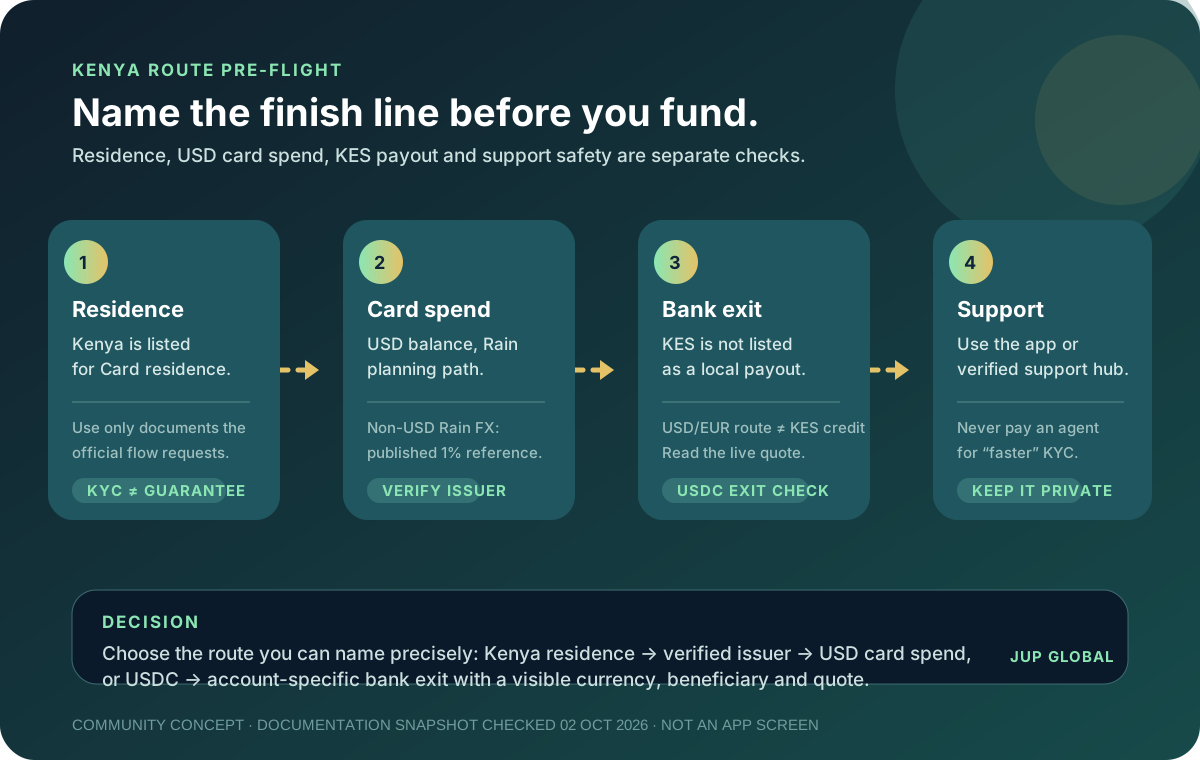
- Card residence: Kenya appears in Jupiter’s active Card-country list. That lets a genuine resident inspect the official verification flow; it does not guarantee approval or every Spend feature.
- Issuer and Card FX: Kenya is outside the published DCS country group, so the public issuer split points toward Rain. Confirm the issuer shown in the verified account before using a fee or limit estimate.
- KES bank payout: KES is not listed in the current local-payout currency rows. Do not describe a direct Kenyan-shilling bank credit as a documented live route.
- QR Pay: Kenya is not in the documented QR Pay merchant-network list, and Spend-balance QR Pay depends on an eligible DCS-issued card.
- Crypto funding: The direct Spend deposit pairs remain asset-and-network specific: USDC on Solana, Ethereum, Sui, Arbitrum or Base, and USDT on Solana.
The current Jupiter Card documentation bases eligibility on country of residence, not citizenship. The Fees & Limits page, Remittance page and QR Pay page publish separate route tables. For the wider residence list, see the supported-countries guide. Check the live app for the account-specific result before moving money.
Match the Kenya search to where the money needs to go
| What you need to do | What the documentation supports | Check before funding or applying |
|---|---|---|
| Pay a Kenyan merchant in KES | A Visa Card purchase may be possible after account approval; the balance is held in USD and a non-USD FX rule can apply. | Confirm the assigned issuer, Card status, merchant currency and final transaction screen. |
| Receive money in a Kenyan bank in KES | KES is absent from the current local-payout currency rows. | Ask the live Remittance flow for the exact currency, rail, fee and expected credit; do not assume a shilling payout. |
| Withdraw a crypto-funded balance | Kenya is not in the published restricted off-ramp table; the current documentation says unlisted regions are supported in all available currencies, and only USDC deposits are documented for fiat withdrawal. | Confirm the Withdrawal screen, destination currency, quote, fee, beneficiary and account-specific availability. |
| Pay by a Kenyan QR code | Kenya is not in the documented Jupiter QR Pay network list. | Identify the merchant network first; a local QR logo is not proof of Jupiter compatibility. |
| Fund Spend with crypto | USDC on Solana, Ethereum, Sui, Arbitrum or Base, and USDT on Solana, are the documented direct deposit pairs. | Match the asset and network shown in the current receiving instructions exactly. |
Your account screens, beneficiary fields and final confirmation decide what’s actually available.
Use your real Kenya residence in verification
The Card flow follows where you actually live. A Kenyan passport held by someone living elsewhere does not establish Kenyan residence, and a visitor, employer address or borrowed address should not be used to force a country selection. Keep the name, residence and identity details in the official flow accurate and consistent.
The Card page names DCS for Australia, Japan, Malaysia, the Philippines, Singapore, South Korea, Taiwan, Thailand and Vietnam. Kenya is outside that group, so Rain is the planning assumption for a Kenyan residence. Issuer assignment is automatic; the Card screen in the verified account is the evidence that matters.
Do not pay an intermediary who promises approval, a faster KYC decision or a special Kenya route. Jupiter’s FAQ says verification uses the official app and Verification Center. Nobody outside Jupiter’s official process can approve an account, change its country or open a payout route. Security guidance · Official support
What a Kenyan card purchase costs
Spend holds the card balance in USD. The app displays the Spend balance in USD; deposited USDC and USDT are not automatically converted to USD on arrival. With Rain, the stablecoins remain on-chain as card collateral. A merchant charging Kenyan shilling is therefore a non-USD Card transaction, not a KES wallet or local bank balance.
The current fee table lists 1% non-USD FX conversion for Rain and 1.8% for DCS. If the account is Rain-issued, the 1% figure is the published rate for a KES purchase. It is not a final quote: the merchant amount, exchange rate, issuer, card state and transaction confirmation decide the actual debit. USD payments have no standard FX conversion fee in the same table. Current fee rules · Complete Jupiter Global fees guide
For a first purchase, use an ordinary low-stakes Visa merchant and keep a backup method. Hotels, rental cars, subscriptions and other merchants may create authorisation holds that affect available balance before settlement. The card-abroad FX guide explains how to record the issuer, currency, fee and transaction state together.
KES payout is not a published local route
The current local-payout table lists currencies such as AED, BRL, CAD, EUR, GBP, IDR, INR, MYR, NGN, PHP, SGD, THB, TRY, USD and VND. KES is absent from those rows. The documentation says specific corridors can be restricted by the recipient bank and local regulations, and other destinations may use SWIFT in supported currencies. That is not the same as receiving Kenyan shilling into a Kenyan bank account.
If you need money in a Kenyan bank, write it precisely: KES credited to this beneficiary account. Then open the current Remittance flow and check whether the account offers a supported currency, a route, the beneficiary fields, the fee and the expected credited amount. Do not turn “SWIFT covers over 200 countries” into a promise that any Kenyan bank will accept every currency. Global Fiat Remittance
The corridor checklist and quote comparison tool can organize the questions, but neither can open a corridor or approve a beneficiary.
Kenya is not a documented QR Pay market
Jupiter’s current QR Pay list names Cambodia, Indonesia, Malaysia, Mongolia, the Philippines and Vietnam. Singapore and Thailand are temporarily unavailable, and Kenya is not listed. QR Pay also depends on a DCS-issued card. A Kenyan merchant QR code may belong to M-Pesa, a bank or another wallet network outside Jupiter’s documented route.
If you need to pay a Kenyan merchant, check the ordinary Visa Card path, the USD balance and the FX condition. Do not treat a supported Card residence as proof that QR scanning will work. QR Pay availability
A safe Kenya KYC and funding preflight
Before applying or funding, use this order:
1. Confirm Kenya is your real country of residence for the official verification flow. 2. Use only the documents and fields the current app requests. Do not assume a Kenyan ID, utility bill or other document is accepted until the official flow shows it. 3. Confirm the assigned issuer and Card status after verification. 4. Decide whether the goal is a KES merchant purchase, a separate USD/EUR bank-transfer route or an account-specific off-ramp. 5. If funding crypto, match the exact documented pairs: USDC on Solana, Ethereum, Sui, Arbitrum or Base, or USDT on Solana. 6. If a route is missing or an application is pending, use official in-app support with the status message and reference. Never send documents, passwords, one-time codes or recovery phrases to a private “agent.”
Jupiter’s FAQ says routine verification may take a few minutes while manual review can take 3–5 working days. That is an informational range, not a service-level promise. The KYC pending guide, KYC rejection guide and support guide cover the evidence to keep without publishing private identity data.
Kenya does not appear in the restricted off-ramp table. Jupiter’s current fees page says regions not listed there are supported in all available currencies, but that documentation default still does not prove a route is visible for a particular account or that a receiving bank will convert USD into KES on acceptable terms. The off-ramp is partner-powered and region-dependent; the current Withdrawal screen is the actionable source.
Aim for a route you can name: Kenya residence → verified issuer → USD card spending with the documented FX boundary, or USDC → an account-specific bank exit with a visible currency, beneficiary and quote. Use the route finder to write it down, and the deposit network check before funding. If that route suits you in Kenya, open a Jupiter Global account and check the Card and Withdrawal screens before funding. You’ll get 2% cashback on eligible card spending, up to $100 a month.
Jupiter Global Kenya FAQ
Can residents of Kenya use Jupiter Global?
Kenya appears in Jupiter’s current Card country-of-residence list, so a genuine resident can inspect the official verification flow. That does not guarantee approval, a particular issuer decision, a KES payout, or access to every Spend feature.
Does Jupiter Global support KES bank payouts?
KES is absent from the current local-payout currency rows. A Kenyan resident should check the live Remittance flow for the exact supported currency, rail, beneficiary fields, fee and expected credit instead of treating Card residence as proof of a Kenyan-shilling bank route.
Can I pay a Kenyan merchant with QR Pay?
Kenya is not in the current Jupiter QR Pay merchant-network list. QR Pay is limited to supported networks and DCS-issued cards, so an M-Pesa, bank or other Kenyan QR code is not automatically a Jupiter payment route.
Which issuer and FX fee should a Kenyan resident expect?
Kenya is outside the named DCS residence group, making Rain the public planning assumption. The current fee table lists 1% for Rain and 1.8% for DCS on non-USD Card payments, but the issuer shown in the verified account and the final transaction screen control the actual result.
Can I withdraw a USDT-funded balance to a Kenyan bank?
The current documentation says only USDC deposits are eligible for fiat withdrawal through the off-ramp; USDT deposits cannot be withdrawn to fiat that way. Check the account-specific Withdrawal screen for the available currency, beneficiary, quote and fee before funding.
Sources
Checked against these sources on 21 October 2026.