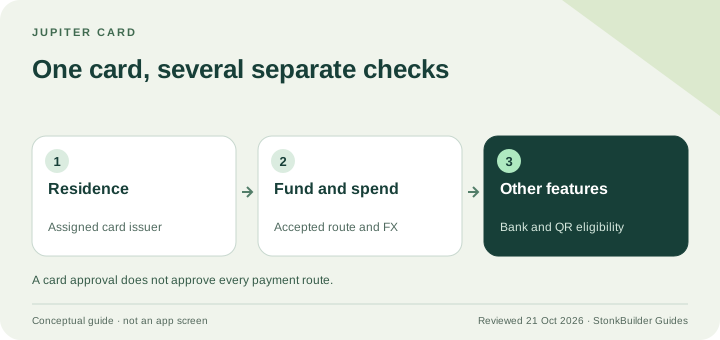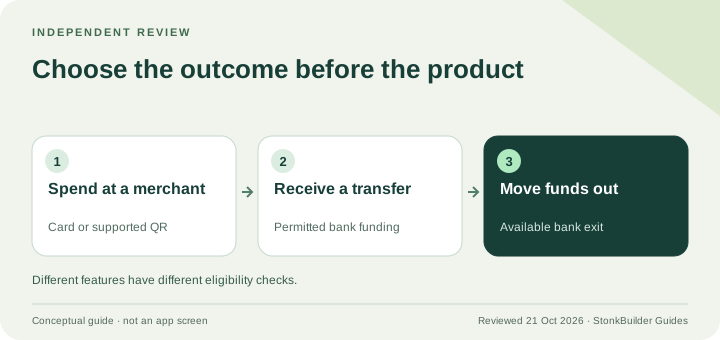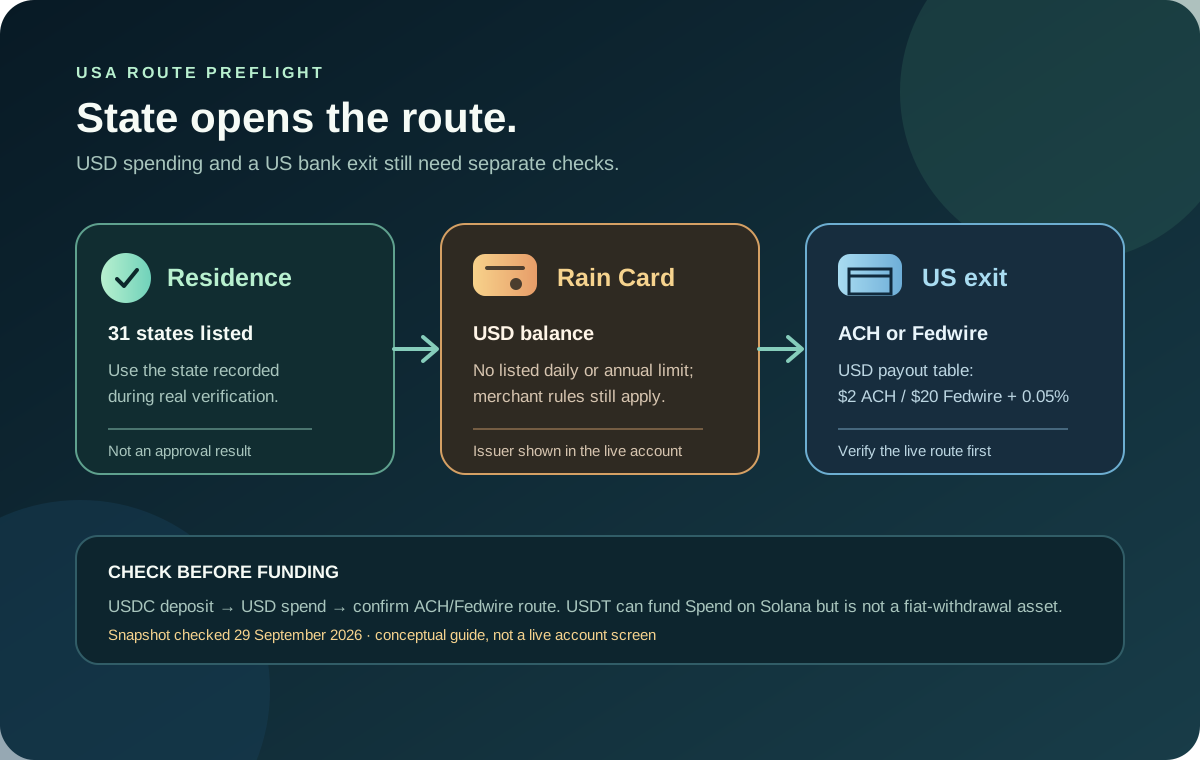
If you live in the United States and are considering Jupiter Global, check your state of residence before you think about funding. The official Card page lists 31 supported states. It also says eligibility is based on residence, not citizenship, and the published issuer table puts residents outside the named DCS countries on Rain. That points to a Rain-issued card for a supported US residence; your approval result will confirm it. Jupiter Card eligibility and issuers
The short USA answer
A US resident can use the Jupiter Card only when the address used for verification is in one of the listed states. Plan around these boundaries:
- The card balance is held in USD, so an ordinary US-dollar purchase does not incur the listed FX conversion fee.
- A US resident should expect the Rain path from the current issuer table; Rain has no published daily or annual spending limit in the current fee table.
- The card is virtual in the app. Physical-card ordering is rolling out in phases and appears only when the account is included.
- A US bank exit is a different route from card spending. The current payout table lists USD ACH and USD Fedwire for the US, with separate fixed and variable fees.
- Only USDC deposits can be withdrawn to fiat under the current documentation. USDT can fund Spend on Solana, but it is not a fiat-withdrawal asset.
These are product-documentation checks, not a promise of KYC approval, a guaranteed limit, or a live account feature. Current fees and limits · Risk and availability notes
The 31 supported states
The current Card documentation lists these states:
| Region | States in the published list |
|---|---|
| Northeast | Connecticut, Maine, Massachusetts, New Hampshire, New Jersey, New York, Pennsylvania |
| Midwest | Illinois, Indiana, Iowa, Kansas, Kentucky, Michigan, Minnesota, Nebraska |
| South | Alabama, Arkansas, Florida, North Carolina, Oklahoma, South Carolina, Texas, Virginia, West Virginia |
| West | Alaska, California, Colorado, Hawaii, Montana, Utah, Wyoming |
Check the official page before applying because the list can change and because the document says a country or state list is not an account approval. The page lists supported US states separately from its international country list; a US territory or an unlisted state should not be treated as covered by the table. Supported-state list
Residence is the decisive input. A US citizen living abroad does not become eligible merely by holding a US passport, and a visitor in a supported state does not change the residence used for verification. Keep the address and identity information in the application consistent with the real situation.
Card residence and bank-deposit availability are separate lists
The published Card state list does not answer every banking question. Jupiter’s current remittance documentation says incoming bank deposits to virtual accounts are temporarily unavailable in California, New York, Connecticut and Puerto Rico. That is a restriction on the bank-deposit route; it should not be read as deleting those places from the Card state table or as proving that an ACH/Fedwire payout will appear for a particular account.
| Question | What to verify |
|---|---|
| Can I apply for the Card? | Your real state of residence appears in the current Card list and the official verification flow accepts your details. |
| Can I receive a bank deposit? | The live USD/EUR virtual-account route is available for your state; the remittance page currently flags California, New York, Connecticut and Puerto Rico as temporarily unavailable for bank deposits. |
| Can I send funds to a US bank? | The live payout route, beneficiary fields, asset restriction and final quote shown in the app. |
Do not infer one answer from another. A listed Card state, a visible virtual account, and an outbound payout are separate product gates. Current remittance limitations
What the Rain path means for a US resident
The current issuer table names DCS for Australia, Japan, Malaysia, the Philippines, Singapore, South Korea, Taiwan, Thailand and Vietnam. Residents of the other supported locations receive Rain, so the table points to Rain for a supported US address. Confirm the issuer displayed in the account before using a limit or fee estimate. Card issuers
The current Fees & Limits page lists Rain card spending as having no daily or annual limit in its comparison table. That is a published product limit, not permission to ignore merchant, compliance, fraud or account controls. Transactions can still be declined by the merchant, issuer or a restricted merchant-category rule. Spending limits and restricted categories
USD spending is the easy part; the bank exit is separate
US-dollar purchases are the cleanest card route. USDC deposited through the documented Spend flow becomes a USD balance before payment, and the fee page says there is no FX conversion fee for USD payments. A non-USD purchase still follows the Rain FX rule, even when the user lives in the United States. Card process · Fee table
A withdrawal to a US bank is a separate decision. The current payout table lists:
| Route | Fixed fee | Variable fee |
|---|---|---|
| USD → US via ACH | $2.00 | 0.05% |
| USD → US via Fedwire | $20.00 | 0.05% |
The page also says withdrawals are region-dependent and that only USDC deposits can be withdrawn to fiat. Check the route shown in the live account, the receiving currency, the beneficiary fields and the final quote before funding for an exit. The bank-transfer corridor checker explains the evidence to capture, and the fee break-even calculator can compare a fixed-fee rail without pretending to confirm availability.
Do not confuse a USD card balance with a US bank account. Card spend, virtual-account funding and off-ramp availability have different screens, fees and settlement rules.
Funding must still match the asset and network
The direct Spend deposit address accepts USDC on Solana, Ethereum, Sui, Arbitrum or Base and USDT on Solana. The FAQ says another token or unsupported network sent to that address can be permanently lost. If the funds already sit in Jupiter Mobile, Send → Send to Spend is the safer conversion route because it swaps the selected token and shows the estimated result before confirmation. Funding overview · Spend FAQ · Deposit safety guide
For a US bank-exit goal, choose USDC and verify the withdrawal route first. A successful deposit only proves that the asset reached Spend; it does not prove that ACH or Fedwire is available for the account.
Merchant restrictions can look like a broken card
The fee documentation lists restricted categories that may be automatically declined, including money transfers and quasi-cash loads, securities brokers and some financial institutions, gambling, adult services, certain government or loan payments, and other dynamically restricted merchants. A US merchant accepting Visa in general can still be outside the allowed category rules. Restricted merchant categories
If a purchase fails, freeze or unfreeze status, available USD balance, merchant category, transaction details and any pending authorization are better first checks than repeatedly submitting the same payment. The card-declined guide covers that sequence.
US signup preflight
1. Confirm the real state of residence is in the current official list. 2. Confirm the account shows the expected issuer and the available card type. 3. Decide whether the goal is USD card spending or a bank exit; they are different routes. 4. If funding, match USDC or USDT to the exact supported network, and prefer USDC when fiat withdrawal matters. 5. For ACH or Fedwire, verify the live corridor, beneficiary data, final amount and fee before sending a larger amount. 6. Test one small, ordinary purchase and keep its transaction reference until settlement is clear.
Use the residence and feature checker first, then the Route Finder to separate a card purchase from an ACH or Fedwire exit. Neither tool can see your account, approve a state or fetch a live quote.
Jupiter Global USA FAQ
Is Jupiter Global available in every US state?
No. The current Card documentation lists 31 supported states. State support is a residence check, not a guarantee of KYC approval or access to every feature. Recheck the official list before applying because coverage can change.
Can a US resident withdraw Jupiter Global funds to ACH?
The current payout table lists USD ACH and Fedwire routes for the United States, with separate fees and beneficiary requirements. The live account must still show the route for your account, and only the documented withdrawal asset can be used for a fiat exit. Confirm the quote and receiving details before funding.
Does the Jupiter Card charge a fee for US purchases?
The fee documentation says USD payments do not incur the listed FX conversion fee. A purchase in another currency follows the assigned issuer’s FX rule, and merchant-category restrictions or account controls can still decline a transaction.
Can USDT be withdrawn to a US bank?
No. The current documentation separates supported Spend deposits from fiat withdrawals and says USDT deposits cannot be withdrawn to fiat. Use the exact asset, network and exit shown in the current account instructions.
The supported-countries guide gives the wider availability picture, and the Jupiter Global review compares the card, bank and QR options. If your state is on the list, sign up for Jupiter Global and you’ll earn 2% cashback on eligible Jupiter Card purchases, up to $100 a month.
Sources
Checked against these sources on 7 October 2026.