There are several answers to whether Jupiter Global works in Vietnam. Vietnam is listed as a supported card-residence market, residents are assigned the DCS issuer, VietQR is a documented merchant network, and VND appears in the local-payout table. Each fact covers a separate route, and none of them guarantees approval, every merchant QR code, a particular Vietnamese bank or a successful transfer. Jupiter Card · QR Pay · Local payouts
Jup Global Community is an independent learning site published by StonkBuilder.
The Vietnam answer in one minute
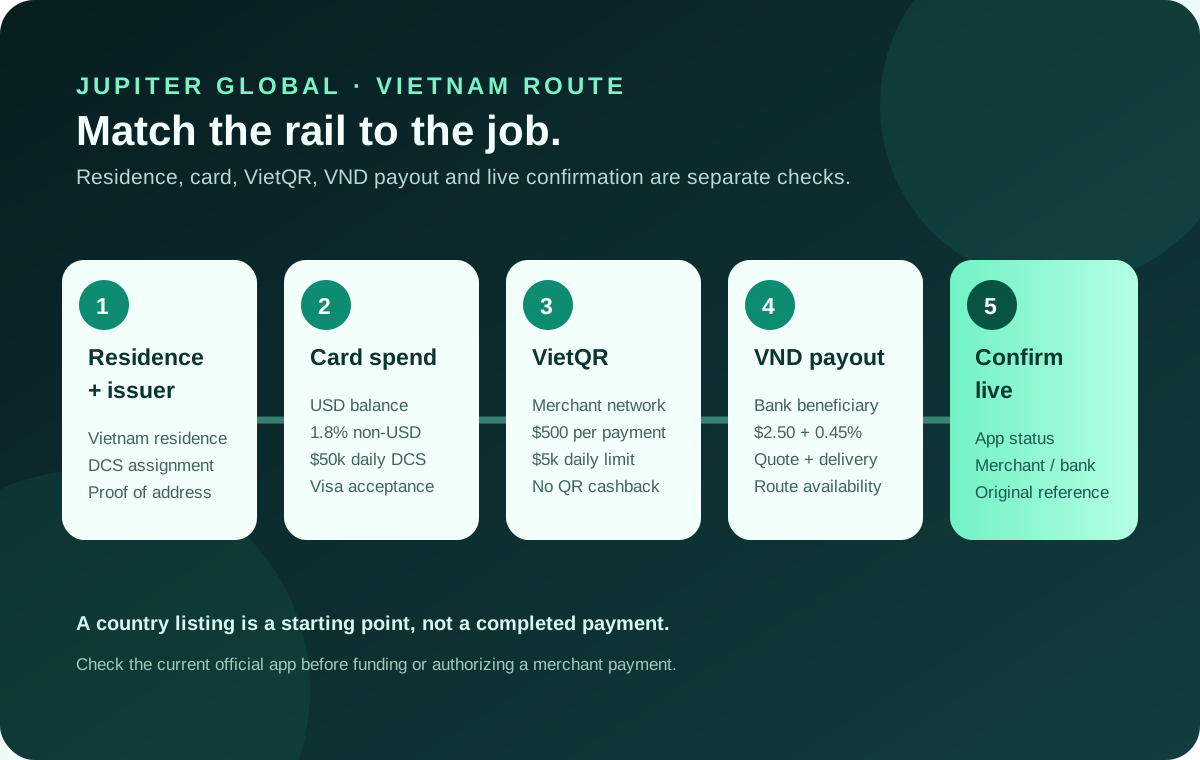
- Card residence: Vietnam appears in the current active country list. Eligibility follows actual residence, not citizenship, and the identity flow can request proof of address.
- Issuer: Vietnamese residents are assigned DCS. The current DCS table lists a 1.8% fee on non-USD payments, a $50,000 daily limit and a $990,000 annual limit.
- QR Pay: VietQR is the documented Vietnam merchant network. The card matrix says cards issued in Vietnam support QR Pay on all cards, but the account still needs a funded Spend balance and completed Jupiter ID verification.
- VND payout: VND appears in the local-payout list. The current payout table shows a $2.50 fixed fee plus 0.45% variable fee for a Vietnam bank transfer, subject to the live route and beneficiary checks.
The current app is the final authority. A published country row is a useful starting point, not an approval or a promise that a route will appear in your account.
Card eligibility is a residence question
Jupiter’s Card documentation bases eligibility on the country where you live. If you live in Vietnam, use the real Vietnamese residence in the onboarding flow and keep the address details consistent with the evidence you can provide. A Vietnamese citizen living elsewhere should check the country of actual residence rather than selecting Vietnam because of nationality.
Vietnam is listed among the countries where the card is actively offered, while unlisted countries are reviewed case by case during KYC. Do not use a hotel, a relative’s address or borrowed documents to force a country result. The correct next step is an honest residence selection followed by the official identity checks. Card country rules
Vietnamese residents are assigned DCS automatically. That means the DCS fee and limit table is the relevant planning reference for a Vietnam account; you cannot choose Rain instead. A supported residence still does not guarantee immediate physical-card availability, mobile-wallet support or acceptance at every merchant. Card issuer details
VietQR is a merchant route, not every QR code
The current QR Pay page lists VietQR for Vietnam. QR Pay starts from the Spend home screen, scans a merchant code, and settles from the USD Spend balance through local payment rails. The merchant does not need a Jupiter-specific integration, but the code must belong to a supported merchant network and payment type.
The card matrix says cards issued in Vietnam, the Philippines, South Korea and Taiwan support QR Pay on all cards. That is the useful country-specific detail: QR Pay still depends on the card, but Vietnam is not subject to the older activation-date exceptions listed for some other markets. An ordinary bank-transfer QR, personal wallet QR or P2P code can still be outside the supported merchant flow. QR Pay card matrix
QR Pay has no payer or recipient fee, including the documented currency conversion, but it has a $500 per-transaction limit and a $5,000 daily limit. QR payments do not earn card cashback. Before authorizing, compare the merchant name, amount and currency; if a scan remains pending, preserve the original reference and use official support instead of scanning repeatedly. QR limits and exclusions · Security guidance
VND payouts work differently
VND in the remittance table answers a bank-transfer question, not a QR question. The current fee table lists the Vietnam bank-transfer row at $2.50 fixed plus 0.45% variable. That’s the published rate. Your live quote, beneficiary fields, destination bank, delivery estimate and account eligibility determine whether a specific transfer can proceed. Current VND fee row
Before funding, write down the outcome you need: VND credited to this exact beneficiary account. Then compare the complete debit with the VND amount expected to arrive. A merchant QR payment, a card purchase and a local bank payout are different products; do not compare them only by their currency symbol.
The remittance page describes USD and EUR virtual accounts funded by incoming fiat transfers. Those accounts credit the Spend balance; they do not create a Vietnamese VND bank account. Seeing VND in a payout list also does not guarantee every Vietnamese bank or beneficiary format. Confirm the legal name, account number, bank details and displayed quote inside the current official flow. Global Fiat Remittance
The balance and FX check
The Jupiter Card draws from a USD Spend balance. The app displays the Spend balance in USD; deposited USDC and USDT are not automatically converted to USD on arrival. With Rain, the stablecoins remain on-chain as card collateral. A VND card purchase is therefore a non-USD card payment, not a withdrawal from a separate VND wallet. The DCS fee table currently lists 1.8% on non-USD payments and no fee on USD payments. Balance mechanics · Issuer fees
Before a large or time-sensitive purchase, inspect the final VND amount, any merchant currency-conversion offer and the remaining USD balance. Keep a second payment method for transport, lodging and other situations where a decline cannot be solved at the terminal.
Choose the route by the job
| Your real goal | Route to investigate | Main check |
|---|---|---|
| Pay a Vietnamese merchant in person | VietQR | Merchant network, card matrix, amount and QR limit |
| Send dong to a person’s bank account | VND local payout | Beneficiary fields, quote, bank and delivery estimate |
| Pay a Vietnamese merchant by Visa | Jupiter Card | DCS FX fee, available USD balance and merchant category |
| Fund Spend before any of those | USDC or USDT deposit | Exact asset, network and receiving screen |
If you need a family remittance, do not use a merchant QR code as a substitute. If you need an in-person checkout, do not assume a VND payout row makes every QR code compatible. Use the payment-route guide and deposit safety checklist to separate those decisions.
Vietnam preflight
1. Confirm Vietnam is your actual country of residence for KYC. 2. Check the live account’s assigned DCS issuer, card state and available USD balance. 3. For VietQR, confirm the code is a merchant QR and compare the merchant, amount and currency before authorizing. 4. For VND payout, confirm the beneficiary’s legal details and read the current quote rather than relying on the published fee row. 5. For funding, match the asset and network shown in the current deposit screen. 6. Preserve the original reference if anything is pending; do not submit a duplicate transfer because a recipient has not checked yet.
Use the Route Finder to keep stablecoin, card, bank and country questions separate, and read the official app-download guide before opening the app. Verify the current residence, card, QR or payout details in the official app before funding.
For your own situation, the answer is yes only when your residence, issuer, payment rail, beneficiary or merchant, amount and live confirmation all line up.
If VietQR, card spending or a VND payout fits your plans, create a Jupiter Global account and start earning 2% cashback on eligible Jupiter Card purchases, up to $100 a month.
Jupiter Global Vietnam FAQ
Is Jupiter Global available in Vietnam?
Vietnam is listed as a supported card-residence market in the checked documentation, with DCS issuance, VietQR merchant payments and VND payout rows. Those are separate routes; the live account and official confirmation screen decide personal eligibility.
Can Vietnamese residents use VietQR with Jupiter Global?
The checked QR matrix lists VietQR for Vietnam and says Vietnam-issued cards support QR Pay on all cards. The code still must be a supported merchant QR, the account must be verified and funded, and the payment must remain within current limits.
What are the Vietnam QR Pay limits?
The checked documentation lists $500 per transaction and $5,000 per day. QR Pay does not earn card cashback, and a payment below the ceiling can still fail because of code type, balance, connectivity or account state.
How much does a VND payout to Vietnam cost?
The checked fee table lists $2.50 fixed plus 0.45% variable for the Vietnam bank-transfer row. Treat it as the published rate and use the live quote for the exact account, beneficiary and conversion.
Is a VND payout the same as paying by VietQR?
No. VietQR is a merchant-payment route from the USD Spend balance. A VND bank payout has separate beneficiary fields, corridor rules, fees, timing and reconciliation evidence.
Sources
Checked against these sources on 21 October 2026.