For a Brazilian freelancer, Jupiter Global makes more sense when you start with the payment outcome, not with a headline about a card. You may want to spend a dollar-denominated balance on software, pay a Brazilian merchant in BRL, or move money to a Brazilian bank account. Those are different routes with different fees, eligibility checks and outcomes.
The useful short answer
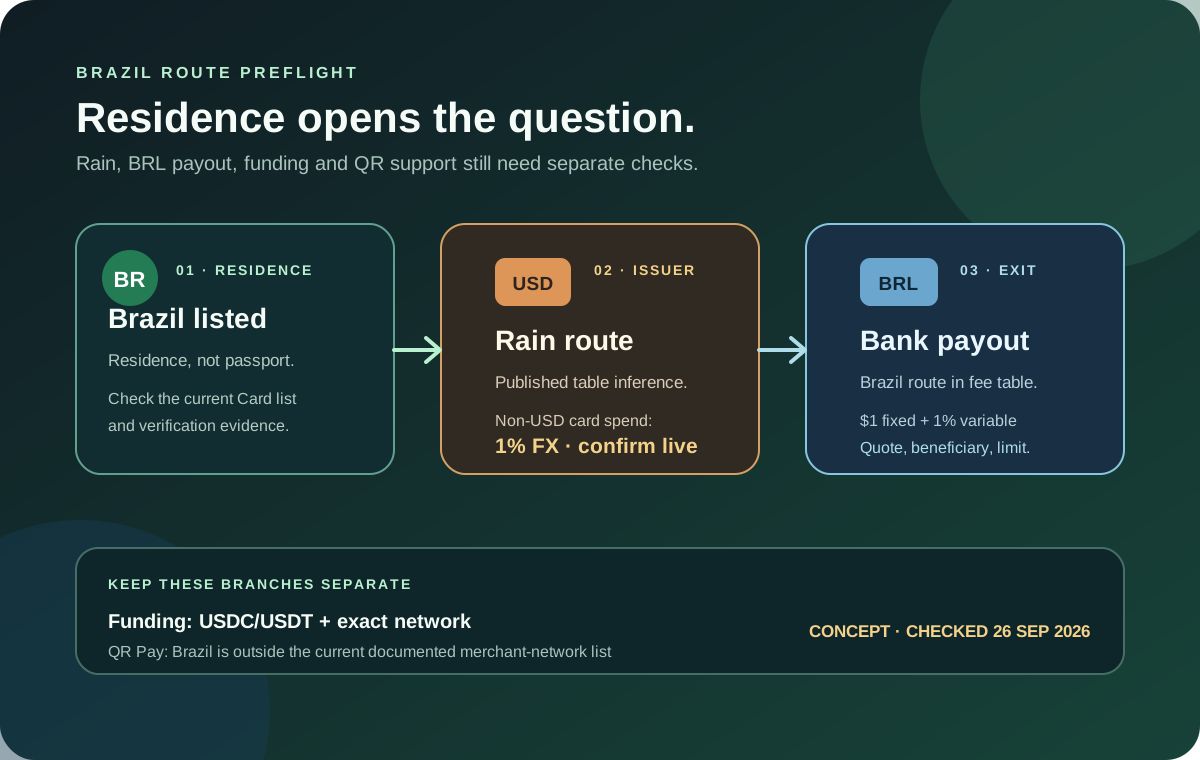
Brazil appears in the current Jupiter Card country list. The issuer table lists DCS for a separate group of Asia-Pacific residences and points to Rain for other supported countries, so a Brazilian residence appears to follow the Rain route. Confirm the issuer in the live account before calculating costs. Card country and issuer table
For a freelancer, the practical split is:
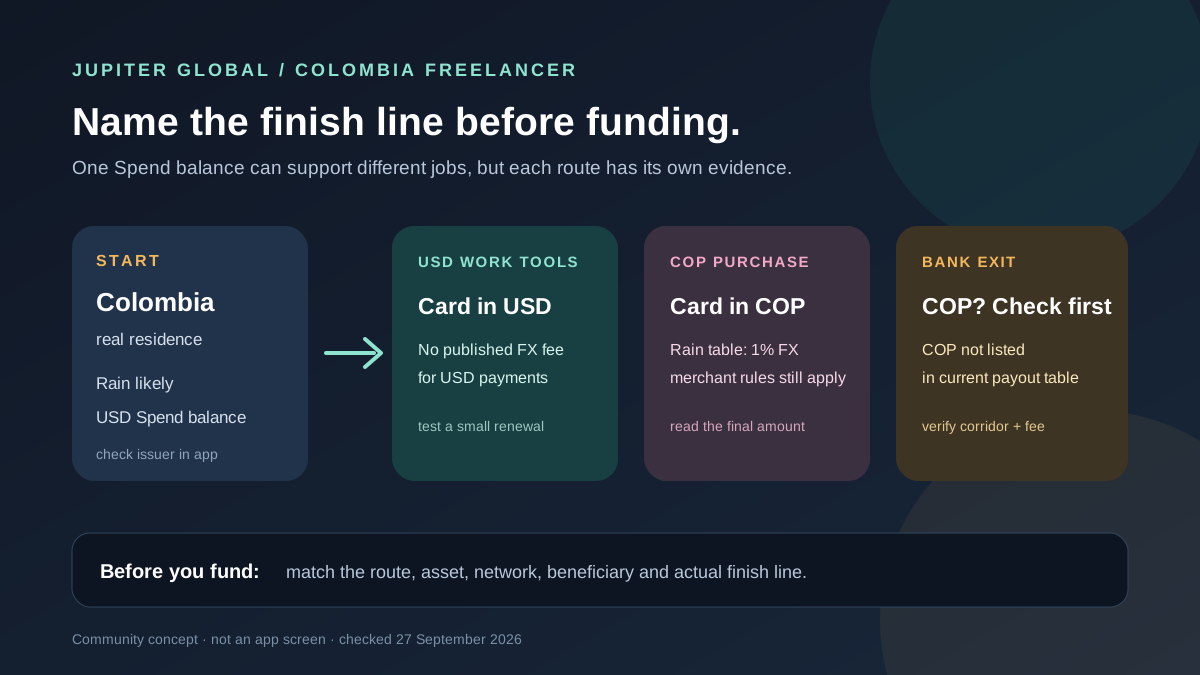
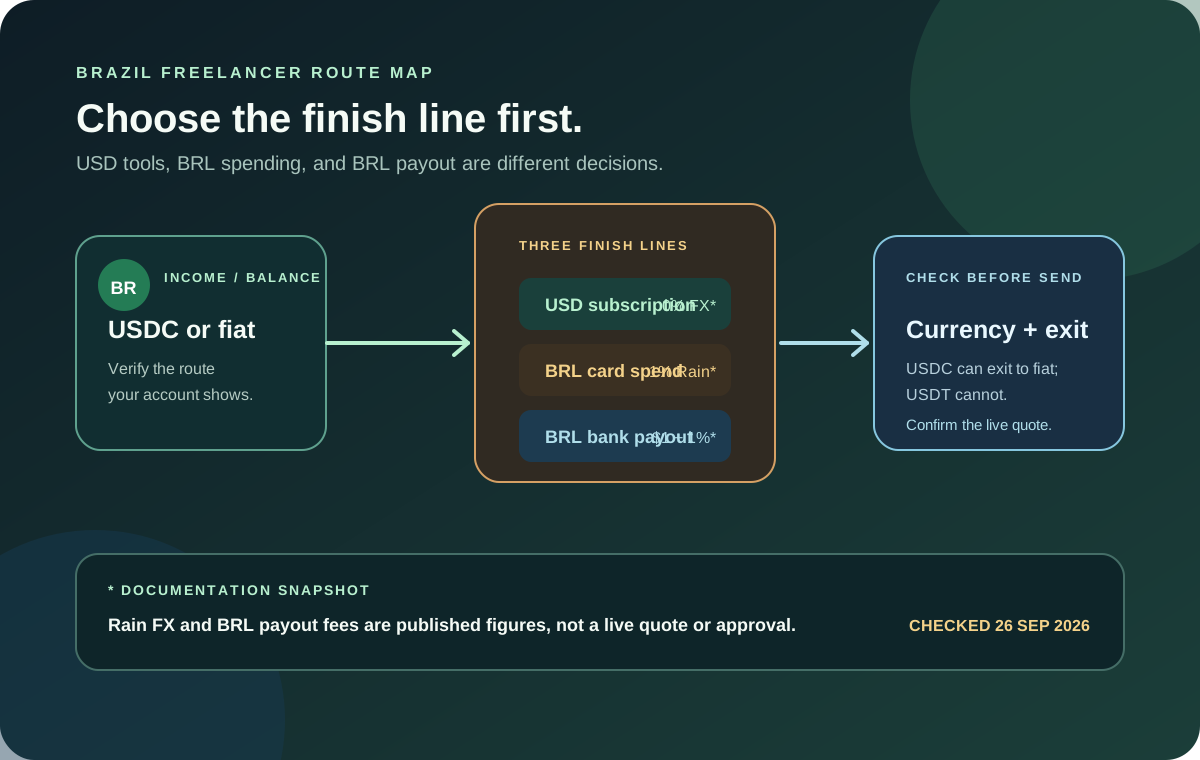
- USD-priced work tools: the card balance is held in USD, and the current fee table lists no FX fee for USD payments.
- BRL purchases: a Rain-issued card currently carries the published 1% FX fee on non-USD payments, before any merchant-side conversion or hold.
- BRL bank payout: the current table lists Brazil at $1 fixed plus 1% variable for a local bank transfer.
- Stablecoin funding: the Spend deposit address accepts the documented USDC and USDT network pairs; USDT cannot be withdrawn to fiat.
This is a route-selection guide, not a promise that a freelancer’s account will receive a particular virtual account, issuer, payout corridor or card feature. Availability depends on residence, verification, partner rules and the current app. Current fees · Remittance boundaries
Decide what the money is for before you fund
Write one sentence before opening a transfer screen:
> “I need to pay a USD subscription.”
> “I need to buy something from a Brazilian merchant in BRL.”
> “I need BRL in my Brazilian bank account.”
Each sentence points to a different check. A card that works for a USD SaaS subscription does not prove that a BRL bank payout is available. A visible BRL payout row does not prove that a card, physical card or QR route is enabled for your account.
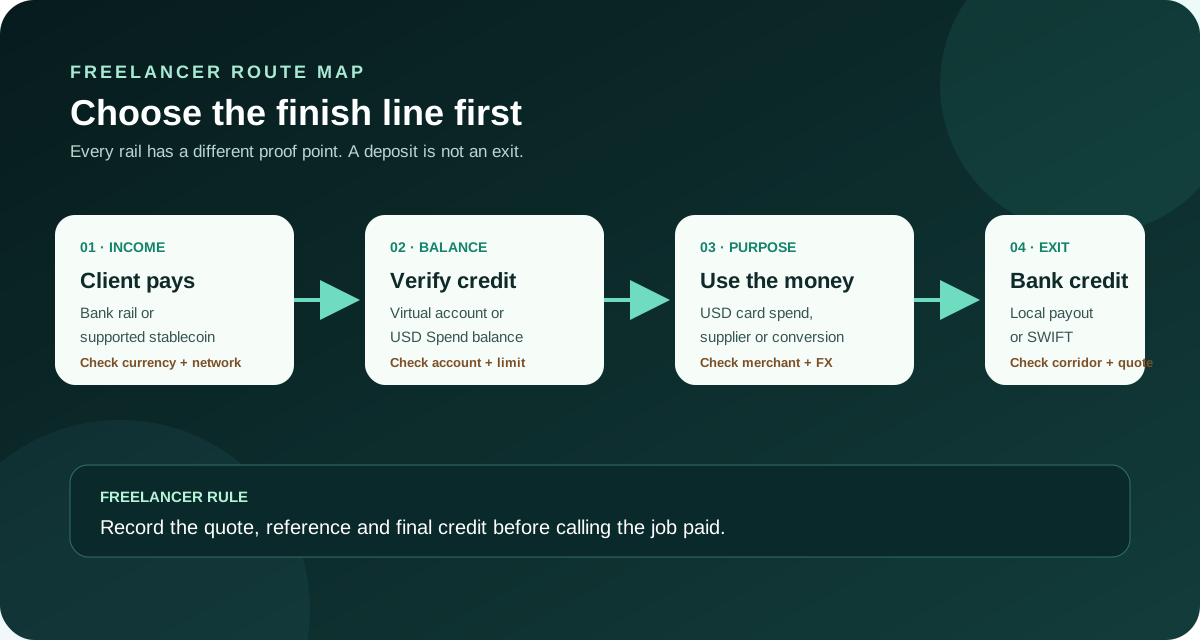
This separation is especially useful for freelancers paid by overseas clients. Do not count a blockchain confirmation, a bank-transfer acceptance message or a merchant receipt as the final result. What counts is the Spend balance, settled card transaction or bank credit you actually needed.
Route A: spend a USD balance on USD-priced tools
The app displays the Spend balance in USD; deposited USDC and USDT are not automatically converted to USD on arrival. With Rain, the stablecoins remain on-chain as card collateral. A USD-billed service therefore avoids the Rain non-USD conversion fee listed in the current table. It still needs an active card, enough available balance, a merchant category that is allowed, and a backup method if the payment is time-sensitive. Card mechanics · Merchant restrictions
Before a recurring software charge, record:
- the billing currency and next renewal date;
- the amount including any trial conversion or authorisation hold;
- the USD balance available after your first test payment;
- the card issuer shown in the app; and
- the merchant’s cancellation and refund path.
Do not treat a USD price on a Brazilian checkout as guaranteed USD settlement. Read the final currency and amount on the merchant screen. A subscription can also retry later after your balance, merchant token or risk decision changes. The subscription preflight and first-card payment checklist cover the evidence to keep.
Route B: pay a Brazilian merchant in BRL
A BRL purchase is a non-USD card payment. The current Rain table lists 1% FX conversion for that route. The fee is only one part of the total: the merchant may add a tip, temporary hold, local conversion or category restriction. Visa acceptance is not a universal approval promise. Fees and limits · Card decline guide
Use a modest ordinary purchase as your first test. Compare the merchant receipt, the currency shown at authorisation and the transaction entry in the app. Avoid using a hotel deposit, rental-car hold or essential travel purchase as the experiment. If the merchant says the payment failed while the app shows a pending entry, pause before repeating it.
Route C: move money to a Brazilian bank
The current payout table lists BRL to Brazil by bank transfer at $1 fixed plus 1% variable. Global Fiat Remittance also states current payout limits set for each currency and shown in the app and says conversions use the market rate. The final account flow still decides whether your beneficiary, corridor, compliance review and delivery window are available. BRL fee row · Remittance process
Before sending, capture the complete quote:
1. Source balance and currency. 2. BRL destination and beneficiary details. 3. Fixed fee and percentage basis. 4. Market-rate conversion and expected BRL amount. 5. Transfer limit, reference and delivery estimate.
The page does not assume that a freelancer can receive client income directly into a virtual account. Jupiter documents USD and EUR virtual accounts after identity verification, with EUR availability dependent on residence; those accounts are funded by incoming fiat transfers, not direct USDC deposits. Ask the current app what route your account actually shows. Virtual-account overview
Stablecoin funding needs an exit plan
If a client pays you in USDC, the documented Spend deposit address accepts USDC on Solana, Ethereum, Sui, Arbitrum or Base. USDT is accepted on Solana. The official FAQ warns that an unsupported asset or network sent to the deposit address may be permanently lost. If the funds are already in Jupiter Mobile, Send → Send to Spend is a separate conversion path that shows the swap result and fees before confirmation. Deposit instructions · Funding overview
If your goal is a BRL bank payout, fund with the exit in mind. The current documentation says only USDC deposits can be withdrawn to fiat; USDT deposits cannot. “Accepted for spending” and “usable for a bank payout” are separate claims. Use the deposit safety guide and the network checker before sending anything.
A freelancer’s preflight
Use this order before committing funds:
1. Confirm your actual country of residence and current verification requirements. 2. Decide whether you need USD spending, BRL spending or a BRL bank credit. 3. Check the issuer, currency, merchant category and current fee screen. 4. Match the exact stablecoin and network, or use the documented wallet conversion route. 5. Enter complete same-time quotes in the Quote Compare tool. 6. Make one modest test and preserve the transaction reference privately.
For the country-level card, payout and QR distinctions, read the Jupiter Global Brazil guide. If you are choosing between a fiat-first transfer and a crypto-funded route, use the Brazil versus Wise comparison and the site’s Route Finder. If that route fits your freelance work, open a Jupiter Global account and check the live screens before moving money. You’ll earn 2% cashback on eligible Jupiter Card purchases, up to $100 a month.
Jupiter Global Brazil freelancer FAQ
Can a Brazilian freelancer use Jupiter Global for USD software subscriptions?
Brazil appears in the current Card country list, and a USD-billed card purchase uses the USD Spend balance without the published non-USD FX fee. Confirm the live issuer, available balance, merchant category and final billing currency before relying on a recurring charge.
What does a BRL card purchase cost for a Brazilian freelancer?
The current Rain fee table lists a 1% FX conversion fee for non-USD card payments. Merchant conversion, tips, temporary holds and category decisions can be separate, so inspect the authorization and settled transaction.
What does a BRL bank payout cost?
The current Brazil payout row lists a $1 fixed fee plus 1% variable fee, and remittance documentation lists payout limits set for each currency and shown in the app. The live quote still controls the beneficiary, conversion, delivery estimate and final BRL amount.
Can a freelancer receive client USDC and later withdraw it to a Brazilian bank?
Spend accepts USDC on Solana, Ethereum, Sui, Arbitrum or Base, and USDT on Solana, but only USDC deposits are documented as withdrawable to fiat. Confirm the live BRL route before funding; an accepted spending asset does not guarantee a bank exit.
Can a Brazilian freelancer receive fiat income into a Jupiter virtual account?
The remittance documentation describes USD and EUR virtual accounts after verification, with EUR availability depending on residence. They are funded by incoming fiat transfers; USDC is sent through the separate Spend deposit route.
Sources
Checked against these sources on 21 October 2026.