If you freelance from Colombia, start with where the money needs to end up rather than the card headline. You may need to pay a USD software subscription, buy something from a Colombian merchant in COP, receive client funds by bank transfer, or move a balance to a bank account. Jupiter Global treats those as different routes with different checks.
The useful short answer
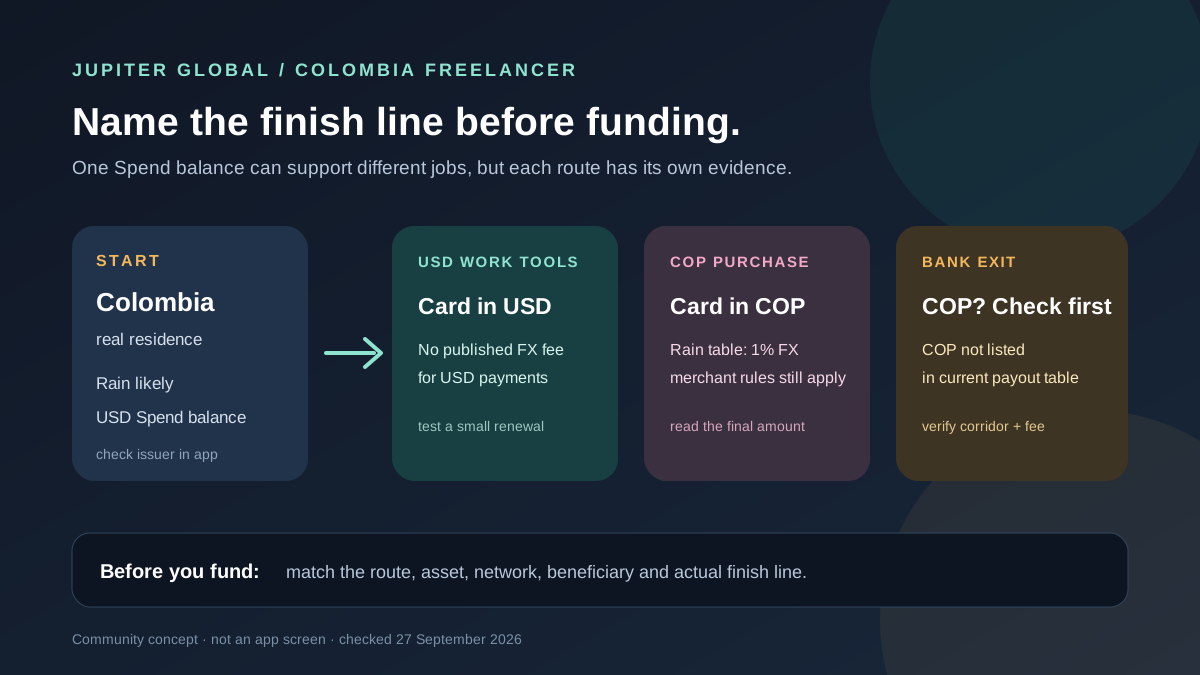
Colombia appears on Jupiter’s current Card residence list. Colombia is outside the named DCS residence group, so the published issuer table points to Rain for a Colombian residence; confirm the issuer shown in the live account before using a fee estimate. Card country and issuer table
The practical split is:
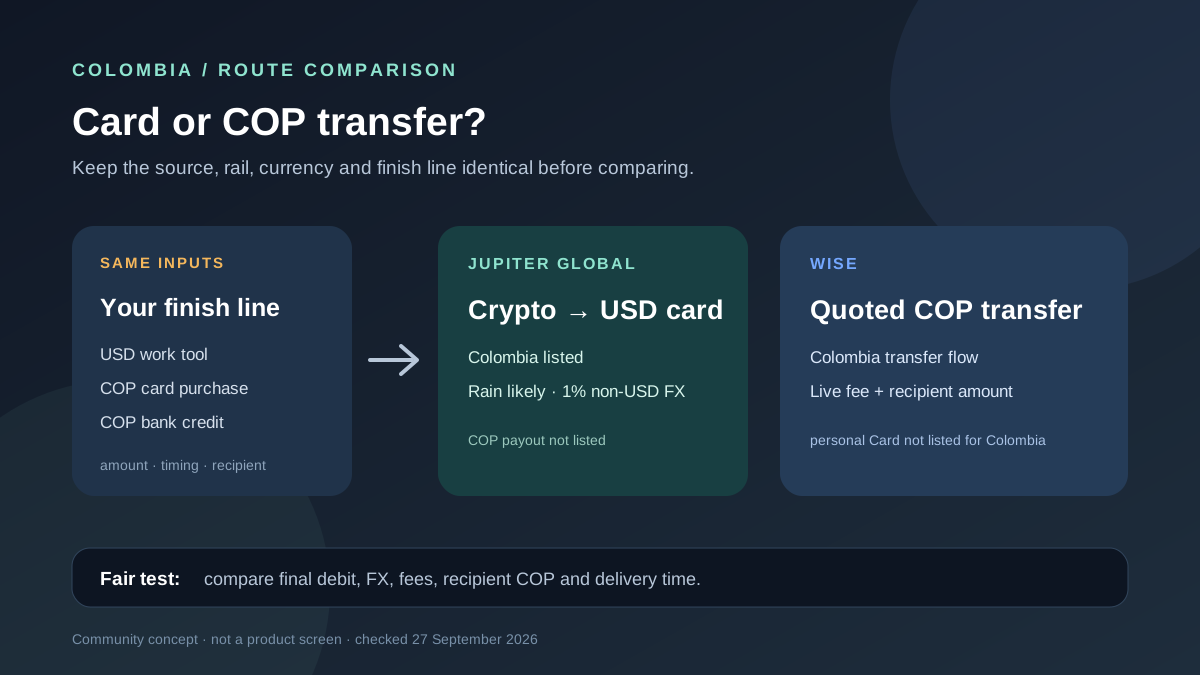
- USD work tools: the Card draws from a USD Spend balance, and the current table lists no FX fee for USD payments.
- COP merchant purchases: a COP payment is a non-USD card transaction; the current Rain table lists a 1% FX conversion fee before any merchant-side conversion or hold.
- COP bank payout: COP is not in the currently published local-payout currency list. A visible card route therefore does not prove that a Colombian bank credit is available.
- Client funding: a virtual account, a crypto deposit, and an outbound bank payout are separate rails. The live app must show the exact route and beneficiary details for your account.
These are documentation checks, not an approval result. Residence, verification, issuer assignment, partner rules, and the route displayed in the account still control what you can use. Current fees and limits · Remittance boundaries
Choose the work outcome before you move money
Write the sentence that describes the real job:
> “I need to pay a USD design or development tool.”
> “I need to buy from a Colombian merchant in COP.”
> “I need money to arrive in a Colombian bank account.”
Those sentences do not lead to the same action. A successful USD subscription does not prove a COP payout. A BRL or USD payout row in the app does not create a Colombian-peso beneficiary. A stablecoin deposit can become spendable without being withdrawable through the route you expected.
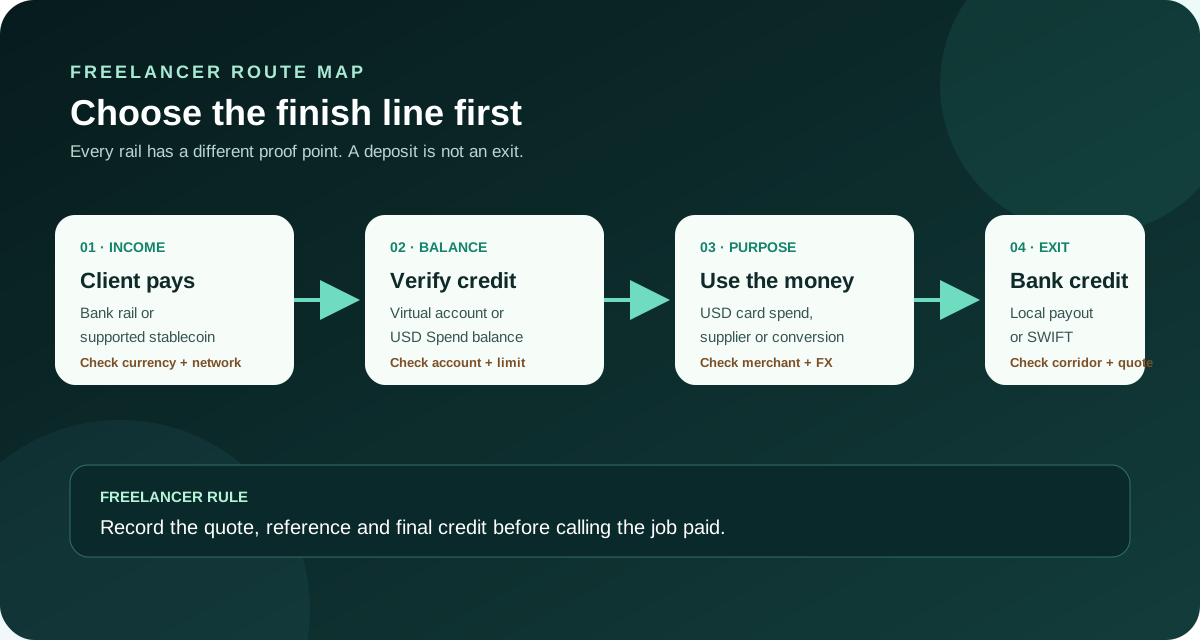
The result that counts is the settled card transaction, visible Spend credit, or bank credit you actually needed. Keep the merchant receipt, transfer reference, or transaction hash attached to that result instead of treating a “sent” or “processing” label as completion.
Route A: pay USD-priced work tools
The app displays the Spend balance in USD; deposited USDC and USDT are not automatically converted to USD on arrival. With Rain, the stablecoins remain on-chain as card collateral. A USD-billed service can therefore avoid the Rain non-USD conversion fee listed in the current fee table. It still needs an active card, enough available balance, an allowed merchant category, and a backup method for a time-sensitive renewal. Card mechanics · Restricted merchant categories
Before authorizing a recurring tool, record the billing currency, renewal date, amount, issuer shown in the app, and the balance left after a small first test. A checkout that displays a dollar sign can still present a different settlement currency or a temporary authorization. Read the final confirmation and do not repeat a payment while the first entry is pending.
Route B: buy in Colombia with COP
A COP purchase is a non-USD card payment. The current fee table lists 1% FX conversion for Rain, while the merchant can add its own conversion choice, tip, preauthorization, or category rule. A Colombian merchant accepting Visa is not proof that every account or purchase will be approved. Card fees
Use a modest ordinary purchase as the first test. Compare the merchant receipt with the currency and amount shown in the app, and keep the transaction reference until it settles. Avoid using a hotel deposit, rental-car hold, or essential business purchase as the first experiment. The card-first-payment checklist covers the evidence to keep if the result is unclear.
Route C: receive or withdraw through a bank
The current remittance documentation lists USD and EUR virtual-account routes after identity verification, with EUR availability dependent on residence. Virtual accounts are funded by incoming fiat bank transfers; they are not blockchain deposit addresses. The current payout table lists several local currencies, but COP is not listed. Virtual-account and remittance rules
That leaves two separate questions for a Colombian freelancer:
1. Can the account receive a client’s USD or EUR bank transfer through a virtual account? 2. Can the account send funds to the intended Colombian bank beneficiary in a currency and corridor the app currently offers?
Do not answer the second question from the first. Before funding, open the live Remittance or Withdrawal screen and capture the source balance, destination currency, beneficiary fields, fixed fee, variable fee, expected delivery, and any corridor notice. SWIFT coverage is broad, but a broad network statement is not a guarantee that a particular Colombian bank, currency, or compliance route is available.
Fund with the exit in mind
For direct crypto deposits, the documented Spend address accepts USDC on Solana, Ethereum, Sui, Arbitrum, or Base, and USDT on Solana. A token and network must both match the current instruction. An unsupported asset or network can be permanently lost. If funds are already in a Jupiter Mobile wallet, the documented Send → Send to Spend path is a separate conversion flow that shows its estimate, minimum received, price impact, and fees before confirmation. Deposit instructions · Funding overview
The asset choice also affects the exit plan: Jupiter’s current documentation says only USDC deposits can be withdrawn to fiat; USDT deposits cannot. If the goal is a Colombian bank credit and the live app does not show a usable corridor, treat the deposit as spending liquidity rather than money already on its way to a bank.
A Colombia freelancer preflight
1. Confirm that Colombia is your real country of residence and that you can complete the current verification steps. 2. Choose one goal: USD work spending, COP merchant spending, a virtual-account receipt, or a bank payout. 3. Check the issuer and current fee screen in the live account. 4. Match the exact asset and network, or use the documented wallet conversion route. 5. Save the complete quote and beneficiary details before confirming a transfer. 6. Make one modest test and keep its receipt, reference, or hash private.
The Jupiter Global Colombia guide covers the country-level card, QR, funding, and payout boundaries. If you are deciding between a crypto-funded card route and a fiat-first COP transfer, read the Jupiter Global versus Wise Colombia comparison and use the site’s Route Finder to settle on your goal. Freelancers who choose the card route can open a Jupiter Global account here and recheck the issuer, currency and beneficiary details before moving funds. You’ll earn 2% cashback on eligible card spending, up to $100 a month.
Jupiter Global Colombia Freelancer FAQ
Can a Colombian freelancer use Jupiter Global for USD software?
Colombia appears in Jupiter’s current Card residence list, and the documented Card draws from a USD Spend balance. A Colombian resident still has to pass the live account’s verification and issuer checks, and the merchant, balance and card state must support the payment.
What fee applies to a COP card purchase?
The current fee table lists a 1% Rain FX conversion fee for non-USD card payments. A merchant conversion, preauthorisation, restricted category or account decision can add a separate outcome, so read the final currency and amount before repeating a charge.
Can Jupiter pay out COP to a Colombian bank?
The checked local-payout table does not list COP. A Colombian Card residence listing does not prove that a Colombian-peso bank payout exists; open the live Remittance or Withdrawal screen and confirm the beneficiary, currency, fee and delivery estimate first.
Should a freelancer deposit USDC or USDT?
Match both the asset and network to the current deposit instructions. Jupiter’s checked documentation says USDC can be withdrawn to fiat while USDT cannot, so the exit plan matters before funding. Unsupported assets or networks can be permanently lost.
What is the safest first test for a freelancer?
Pick one outcome, verify the issuer and route in the live account, make a modest test, and retain the settled receipt, transfer reference or transaction hash. Do not treat a pending card entry or a sent transfer as proof that the final work outcome completed.
Sources
Checked against these sources on 21 October 2026.