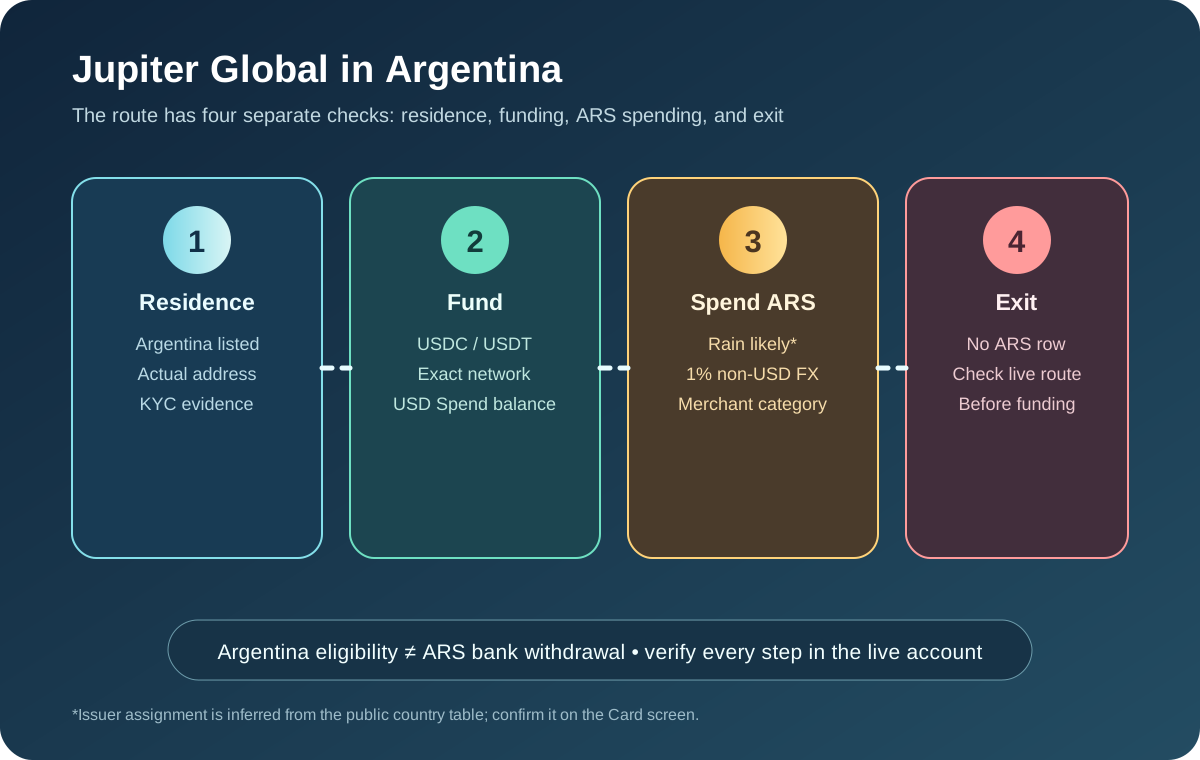
If you live in Argentina, separate the Jupiter Global questions that are often merged together. Argentina appears in the current Jupiter Card country list, so a resident can investigate the account-specific verification route. That does not create an ARS bank balance or prove that an Argentine bank payout is available. The card spends from a USD Spend balance, and the current payout table does not show an ARS local-bank row.
The short answer
| Question | What the current documentation supports |
|---|---|
| Can an Argentine resident apply? | Argentina is listed among the active Jupiter Card residence countries |
| Which issuer is likely? | Argentina is outside the named DCS group, so the public table points toward Rain; confirm the issuer in the live account |
| What does the card spend? | A USD Spend balance funded by supported crypto or an in-app conversion route |
| Can the card pay in ARS? | A Visa card can be used where accepted; an ARS purchase is a non-USD payment and the current Rain FX row is 1% |
| Is an ARS bank payout documented? | No ARS payout row appears in the current Fees & Limits table; do not infer local withdrawal from card eligibility |
| What should be checked first? | Real residence, KYC status, issuer, deposit network, merchant currency and the actual exit route |
These points come from Jupiter’s public documentation. The live Jupiter app and official support flow decide whether a particular application, card, merchant, or payout is available. Start with the current Jupiter Card country rules and Fees & Limits.
Residence is the first gate
Jupiter’s Card documentation bases eligibility on country of residence, not citizenship. Argentina appears in the active list. A person who holds an Argentine passport but lives elsewhere should use the residence recorded in the verification flow, while a non-Argentine citizen who genuinely resides in Argentina should use the country and address they can document. Do not choose Argentina because a friend, phone number, hotel stay, or shipping address makes it convenient.
The same page says that countries not listed may be reviewed case by case and that proof of address is usually required. That statement does not replace the active Argentina row. Keep the information in the Jupiter ID flow consistent with the evidence you can provide. Current Card documentation · Jupiter ID and verification FAQ
The likely issuer is a documentation inference
Jupiter names Rain and DCS as the two card issuers. The DCS list currently names Australia, Japan, Malaysia, the Philippines, Singapore, South Korea, Taiwan, Thailand and Vietnam. Argentina is not in that named DCS group, so the public table points toward a Rain-issued card for an Argentine residence. Treat that as a useful planning assumption only; the account’s Card screen is the final issuer evidence.
The issuer matters because the published foreign-exchange and spending-limit rows differ. The current table lists 1% Rain FX and no Rain daily or annual spending limit, while DCS is listed at 1.8% with its own limits. A country article should therefore never promise a fee or limit before the assigned issuer is visible. Regional fee table
How the balance reaches the card
The card does not spend pesos from an Argentine bank account. The app displays the Spend balance in USD; deposited USDC and USDT are not automatically converted to USD on arrival. With Rain, the stablecoins remain on-chain as card collateral. The external deposit address accepts USDC on Solana, Ethereum, Sui, Arbitrum or Base, and USDT on Solana. The asset and network must match the receiving screen at the moment you send.
If the funds are already in a Jupiter Mobile wallet, the separate Send → Send to Spend route can convert another token into USDC before crediting Spend. That is different from sending an unsupported token directly to the Spend deposit address. Jupiter’s FAQ says an unsupported token sent to that address is lost and cannot be recovered by support. Deposit FAQ · Spend overview
The current fee page lists a $3 minimum on Solana, Base, Arbitrum and Sui, and a $10 minimum on Ethereum. Solana has no processing fee; Ethereum, Base, Arbitrum and Sui charge the higher of $0.30 or 0.02%, plus network gas. Record the network and the amount that actually arrives, and never use an old screenshot for the deposit address or assume that a token listed in another Jupiter product is accepted by Spend.
What an ARS card purchase means
The Spend balance remains USD even when the app lets you display it in another currency. When an Argentine merchant charges ARS, the transaction is a non-USD card payment. The current Rain row lists a 1% foreign-exchange conversion fee for that event; merchant-side conversion, tips, temporary authorisations, restricted categories and the exchange rate shown at confirmation are separate questions.
For a first purchase, record the merchant’s billing currency, the amount authorised, the final settled amount, the issuer shown in the app and the balance change. A merchant offering to “convert to USD” may be using its own conversion rate. Compare the final card result with the amount you expected in ARS, not only the amount shown in a receipt preview. Card mechanics and FX · Current fees
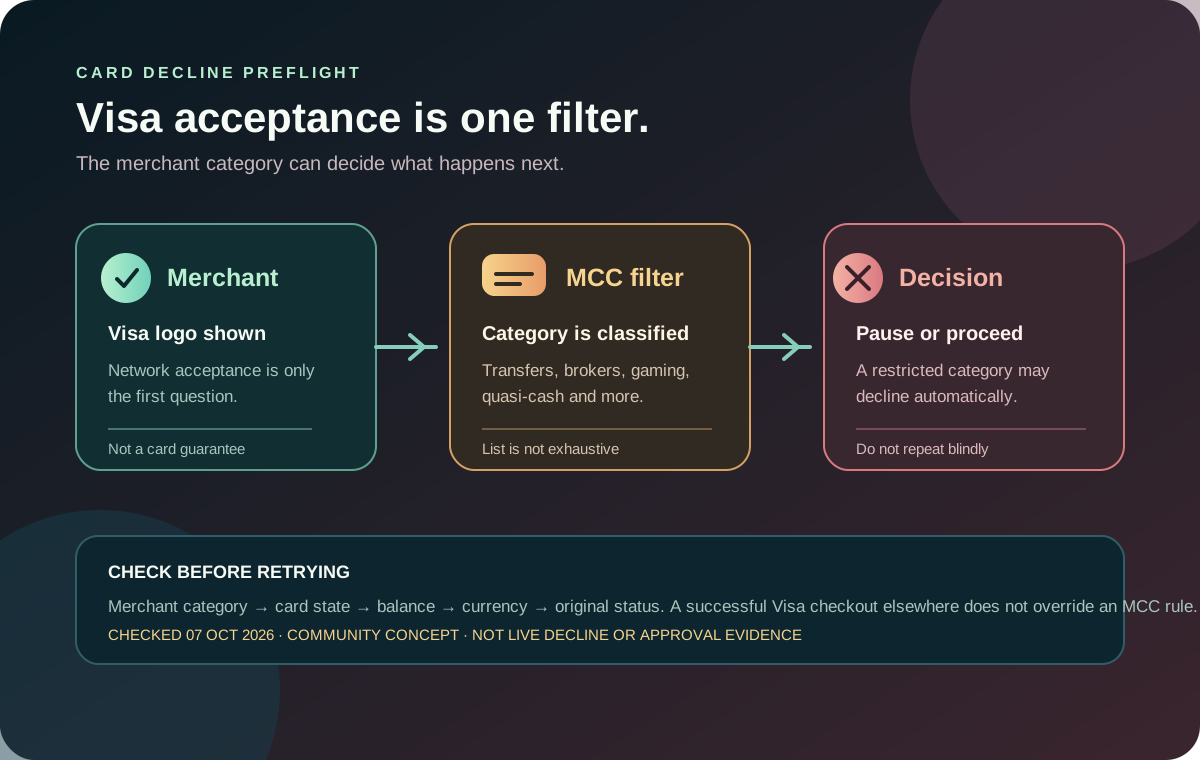
The card can be used anywhere Visa is accepted, but acceptance is not the same as approval. Jupiter’s fee documentation lists restricted categories such as money-transfer services, quasi-cash, gambling, certain financial services and other high-risk merchants. A declined ARS transaction can therefore be a merchant-category or risk decision rather than proof that Argentina is unsupported. Restricted merchant and risk guidance · Risks & Security
The bank-exit boundary
The current payout table lists local rows for currencies including BRL, CAD, EUR, GBP, IDR, INR, MYR, PHP, SGD, THB and VND. It does not list ARS. The page separately says support for some additional currencies is planned, but ARS is not named in that planned list.
That means an Argentine resident should not deposit stablecoins while assuming that a later conversion to an Argentine bank account will exist. A USD or EUR virtual-account route, where offered to the account, is a different bank-rail product and does not prove an ARS payout. The remittance documentation also says virtual accounts are funded by incoming fiat transfers, while crypto deposits use a separate Spend flow. Payout table · Remittance route
Before using a significant amount, open the actual withdrawal or remittance flow and confirm the destination country, currency, rail, beneficiary fields, total debit, recipient amount and delivery estimate. If Argentina or ARS isn’t selectable for what you need, stop there and keep the funds on a route you can explain. Do not create a second transfer to “test” a missing corridor.
Argentina preflight
Use this order before opening or funding the account:
1. Confirm that Argentina is your real country of residence for KYC. 2. Complete Jupiter ID only with documents and an address you can support. 3. Check the assigned issuer on the Card screen. 4. Decide whether the money is for an ARS purchase, a USD subscription, or a bank payout. 5. If funding from elsewhere, match the exact USDC/USDT asset and network. 6. For an ARS purchase, include the current Rain FX row and the merchant’s final currency. 7. For a bank exit, verify that the account actually shows an available route; do not infer it from the country list. 8. Start with a modest amount and preserve the confirmation and transaction reference.
The site’s deposit preflight, first-payment checklist, card-abroad FX guide, and bank-transfer corridor checker cover the adjacent decisions. If the card fits how you spend in Argentina, open a Jupiter Global account and check the live terms first. Eligible Jupiter Card purchases earn 2% cashback, capped at $100 a month.
Use the Route Finder to separate an ARS card purchase, USD subscription and bank-payout goal before you continue.
Jupiter Global Argentina FAQ
Can residents of Argentina apply for the Jupiter Global Card?
Argentina is listed in the current Card country-of-residence table. Approval still depends on genuine residence evidence, identity verification and the live account decision; citizenship or a temporary stay is not a substitute for documented residence.
Which Jupiter Global issuer is mapped to Argentina?
Argentina is outside the named DCS country group, so the public issuer table points toward Rain for an Argentine residence. Treat that as a documentation inference and use the issuer shown in the live Card screen for the applicable fee and limit checks.
What fee applies to an ARS card purchase?
An Argentine-peso purchase is a non-USD card payment because the Spend balance is displayed in USD. The checked Rain table lists a 1% FX conversion fee; merchant conversion, tips, authorisations and other charges can be separate.
Can Jupiter Global withdraw ARS to an Argentine bank account?
ARS is not listed in the current local-payout table. Do not infer an Argentine bank route from Card eligibility or a USD/EUR virtual account; confirm the exact beneficiary, currency and quote in the live remittance flow before funding.
Which assets and networks can fund Spend for an Argentine resident?
The checked deposit route accepts USDC on Solana, Ethereum, Sui, Arbitrum or Base, and USDT on Solana. Match the asset and network shown in the current deposit screen exactly; an unsupported token or network may be unrecoverable.
Sources
Checked against these sources on 21 October 2026.