
Jupiter Global has two different ways to fund the same Spend balance: send fiat to a USD or EUR virtual account, or send supported crypto to a Spend deposit address. The better route depends on where your money starts, what cost you can absorb, and whether you need a bank transfer or a crypto exit later. The Jupiter Global guides directory keeps the funding, corridor, and incident routes together when this comparison exposes a narrower question.
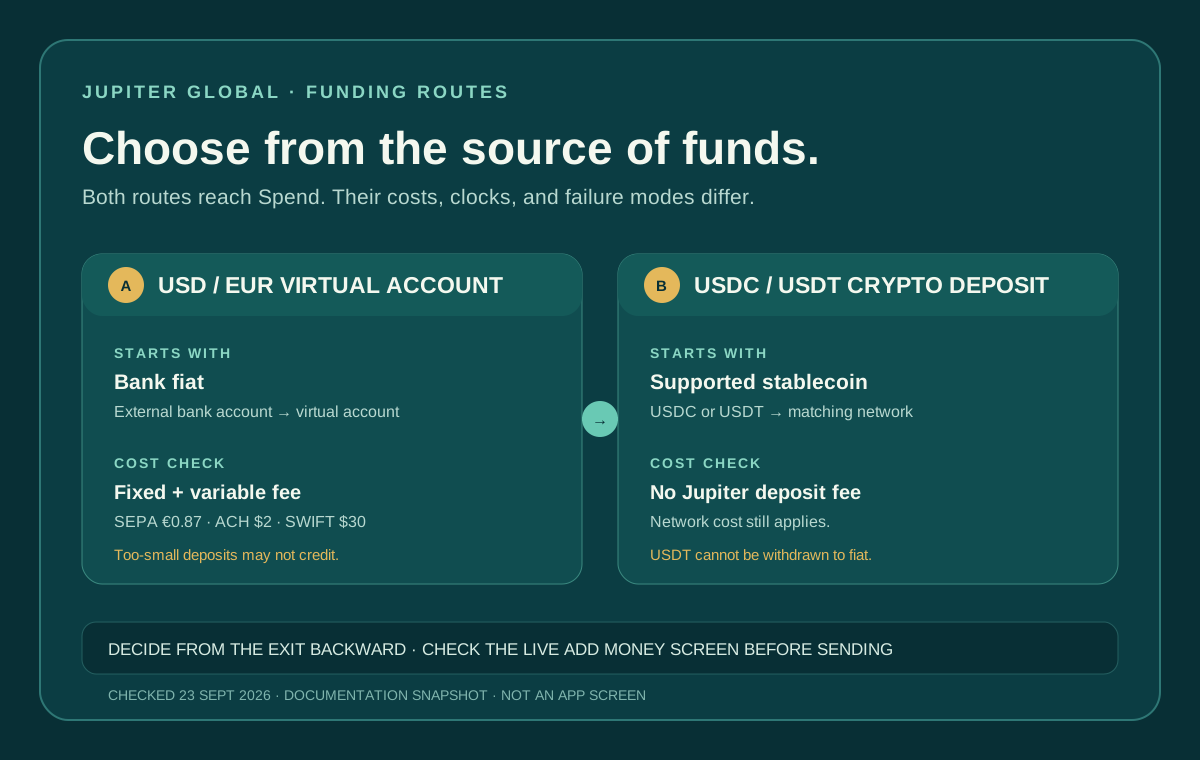
The two routes end at the same balance
Global Fiat Remittance says incoming transfers to a Jupiter virtual account fund the Spend balance directly, the same balance used by the Card and QR Pay. After Jupiter ID verification, users receive USD and EUR virtual accounts; EUR availability can depend on residence. Those accounts are funded by incoming fiat transfers from an external bank account. USDC cannot be deposited directly into a virtual account. Virtual-account funding
The crypto route starts in the Spend tab’s Add Money flow. The current documentation accepts USDC on Solana, Ethereum, Sui, Arbitrum, and Base, and USDT on Solana. Other tokens or an unsupported network should not be inferred to work. Spend funding overview · Deposit FAQ
Choose the virtual account when your money is already fiat
A virtual account is usually the more natural route when the source is a bank account, salary balance, business account, or EUR payment that is already in fiat. It keeps the funding instruction in the bank-rail world: select the currency account, use the current beneficiary details, and retain the bank reference.
The cost is more than a headline “bank transfer fee.” Jupiter’s current pay-in table lists a fixed fee plus a variable fee:
- SEPA: EUR 0.87 plus 0.10% of the USD equivalent.
- ACH: $2.00 plus 0.05%.
- Fedwire: $20.00 plus 0.05%.
- SWIFT: $30.00 plus 0.05%.
These fees are deducted from the deposit. The documentation warns that if a deposit is too small to cover the fees, nothing is credited and the deposit is not refunded. A tiny “test” bank transfer can therefore be the least forgiving test. Current virtual-account fees
Do not choose a rail only because its percentage looks lower. A $2 ACH fee and a $30 SWIFT fee affect small transfers very differently, while a large transfer may be constrained by the payout limit shown for the chosen currency in the app. Confirm the current rail and beneficiary instructions in the app before sending.
The bank route also has current availability boundaries. Jupiter’s remittance documentation says bank deposits are temporarily unavailable in California, New York, Connecticut, and Puerto Rico, and EUR remittances use SEPA only. A virtual account shown in the product does not override a regional or currency-specific restriction. Current remittance boundaries
Choose a crypto deposit when you already hold stablecoins
Crypto is usually the shorter path when your funds are already USDC or USDT and you can verify the exact asset and network. The current table lists a $3 minimum on Solana, Base, Arbitrum and Sui, and $10 on Ethereum. Solana has no processing fee; Ethereum, Base, Arbitrum and Sui charge the higher of $0.30 or 0.02%, plus network gas. Crypto deposit costs
The timing model is also different. Most crypto deposits arrive within about four minutes after the required onchain confirmations, although confirmation requirements and congestion can change the wait. A bank transfer does not use that blockchain clock; keep the bank reference and follow the rail’s current posting expectations instead. Deposit timing
Crypto adds a failure mode that bank rails do not: the asset and network must both match. USDC on the wrong chain is not rescued by the token name. USDT may be accepted for Spend activity, but the FAQ says USDT deposits cannot be withdrawn to fiat; only USDC deposits can be withdrawn to fiat. If a later bank exit matters, decide that before funding. Withdrawal limitation
Decide from the exit backward
Ask these questions before choosing the route:
1. Where is the money now? Bank fiat points toward a virtual account; an existing stablecoin points toward the crypto deposit flow. 2. What currency and rail are available? EUR remittances are supported through SEPA, while other routes may use ACH, Fedwire, or SWIFT depending on the account and destination. 3. What is the smallest economical amount? Compare the fixed bank fee or network cost with the amount you plan to fund. 4. What do you need to do next? Card and QR Pay use the Spend balance, but crypto withdrawal eligibility is asset- and region-dependent. 5. Can you preserve the evidence? Keep the bank transfer reference for fiat; keep the transaction hash, asset, network, and deposit address for crypto.
The virtual-account fee guide goes deeper on bank rails. The USDC versus USDT guide covers the crypto asset choice, and the deposit-network guide adds the pre-send asset-and-chain check before you transfer. The deposit-pending guide explains what to do when a confirmed crypto transaction is not yet visible. The site’s network check helps you match asset and network, but it can’t approve an address or guarantee delivery.
Avoid the four expensive mismatches
- Sending USDC to a virtual-account beneficiary instead of using the crypto deposit address.
- Sending a bank transfer whose amount is smaller than the fixed fee plus the variable fee.
- Choosing a crypto network because it is cheaper on an exchange, even though it is absent from the current Spend screen.
- Choosing USDT before checking whether your intended exit requires fiat withdrawal.
Use the current Add Money instructions, send once, and save the matching reference. If you later need help, describe the exact rail and checkpoint rather than saying only that “the balance is missing.”
A “sent” notification isn’t the goal. You want a credited Spend balance on a route that still supports your next step. The Route Finder helps you name the funding source and that next step before you choose a rail. Once you know which route suits you, sign up for Jupiter Global and check the live funding instructions, asset, network or beneficiary before you send anything. Spending that balance on the card counts too: eligible Jupiter Card purchases earn 2% cashback, up to $100 a month.
Jupiter Global virtual account vs crypto deposit FAQ
Can I send USDC directly to a Jupiter virtual account?
No. Virtual accounts are funded by incoming fiat bank transfers. USDC and USDT use the separate Spend deposit flow with its own supported asset and network pairs.
Which virtual-account currencies can I receive?
After Jupiter ID verification, the documentation describes USD and EUR virtual accounts, with EUR availability depending on residence. Use the current account screen for the beneficiary and rail shown to you.
What fees apply to a virtual-account deposit?
The current pay-in table lists EUR SEPA at €0.87 plus 0.10% of the USD equivalent, ACH at $2 plus 0.05%, Fedwire at $20 plus 0.05%, and SWIFT at $30 plus 0.05%. The live app remains authoritative, and a deposit too small to cover fees may not be credited or refunded.
How quickly does a crypto deposit arrive?
The current FAQ says most crypto deposits arrive in about four minutes after the required onchain confirmations. Congestion and confirmation requirements can change the wait, so keep the transaction hash and do not send a duplicate while the first transfer is pending.
Can I withdraw a USDT deposit to fiat later?
The checked documentation says USDT deposits cannot be withdrawn to fiat; only USDC deposits are documented for fiat withdrawal. Region and account availability still apply, so confirm the exit before choosing the funding asset.
Sources
Checked against these sources on 21 October 2026.