The current Jupiter Spend FAQ lists a $1 USD-equivalent minimum for a bank transfer and a payout limit set for each currency and shown in the app. Those are useful boundaries, but they do not answer whether a tiny payment will be credited efficiently, accepted by a recipient bank, or worth using as a test. The route, fixed fees, and purpose still matter. The Jupiter Global guides directory keeps transfer thresholds, fee comparisons, first tests, and incident routes together before you authorize a payment.
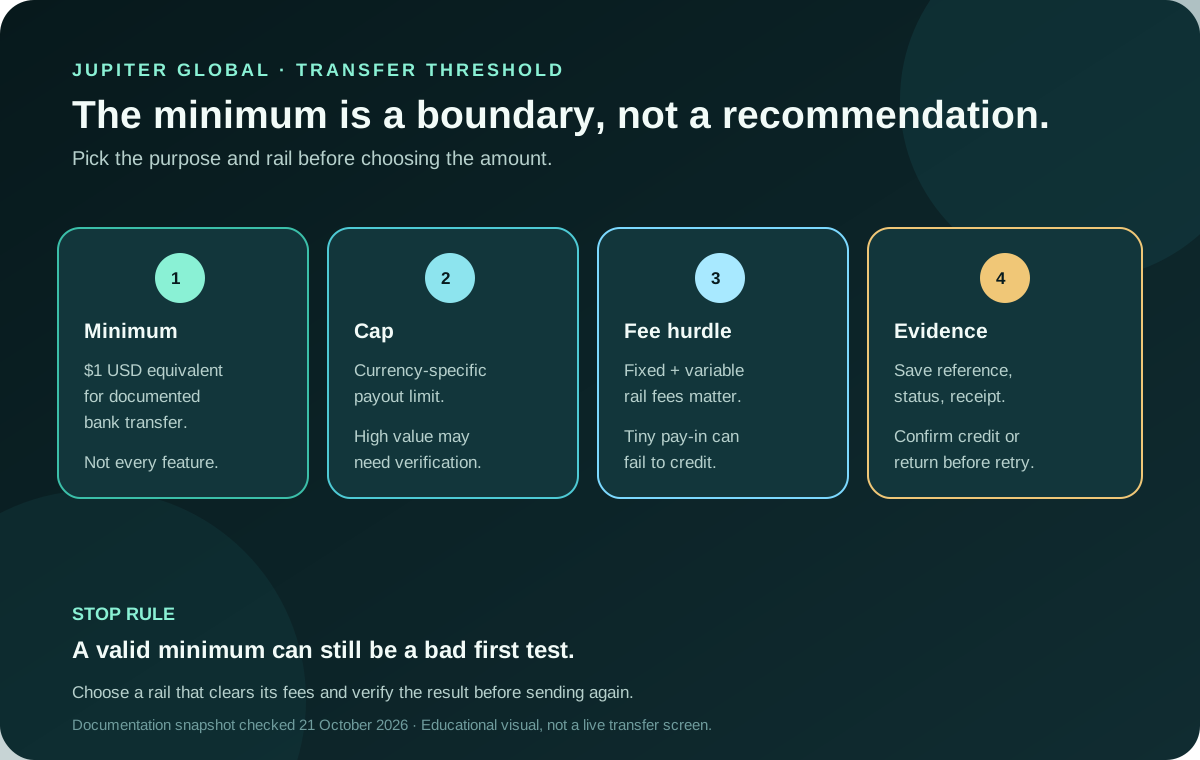
What the $1 minimum refers to
The $1 floor appears in the FAQ’s Bank Transfer section, which covers Global Fiat Remittance through virtual accounts, SWIFT transfers, and local payouts. It is a documented minimum for that transfer feature, not a universal minimum for every deposit, card purchase, QR payment, or bank rail. Transfer FAQ
The same FAQ says high-value transfers may require additional verification. A number shown in a public table does not override a route-specific prompt in the app or a receiving bank’s requirements. Transfer conditions
Why a $1 transfer can be a poor test
Funding and payout fees can include fixed charges. The current pay-in table lists fixed fees for SEPA, ACH, Fedwire, and SWIFT, while outgoing local payouts have their own fixed and variable charges. If a deposit is too small to cover its fees, the documentation says nothing is credited and the deposit is not refunded. Fee table
That means a transfer can satisfy the nominal $1 minimum and still be a poor economic choice. A small test should be valid for the selected rail after fees, large enough to leave a usable result, and small enough that you can tolerate a delay or investigation.
Keep the floor and the cap separate
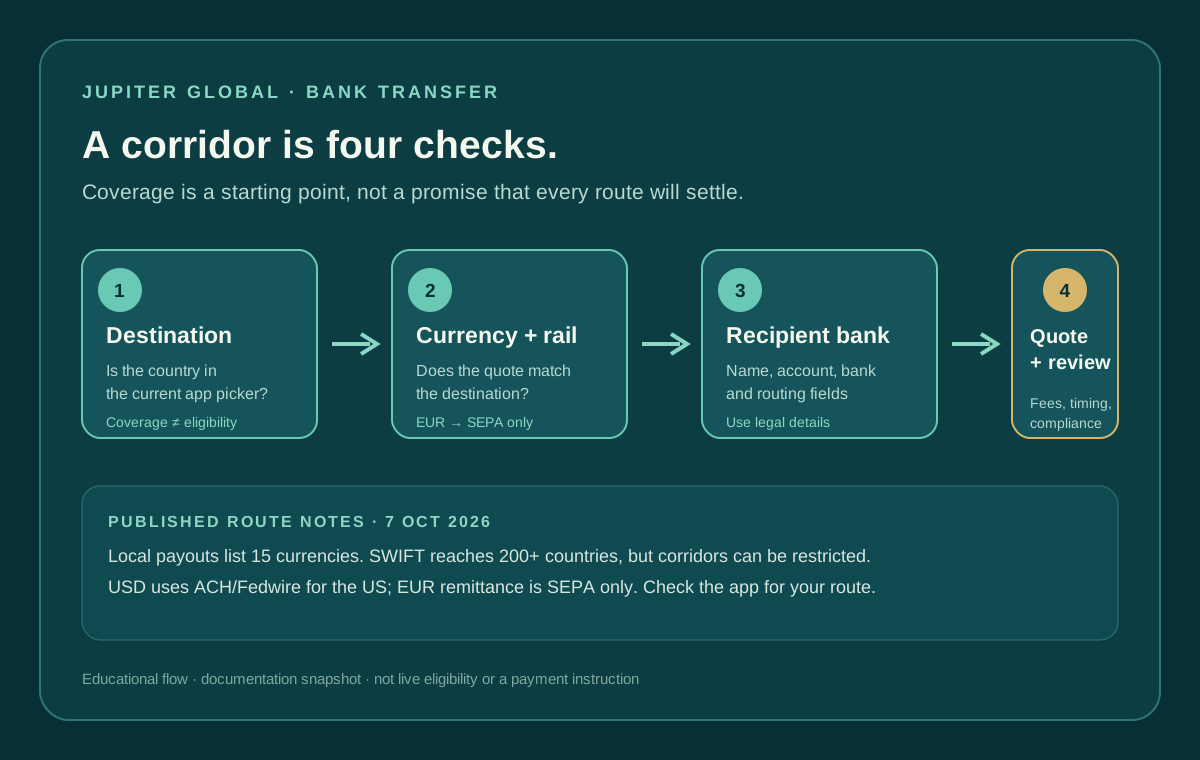
The minimum answers “how small can the documented transfer be?” The maximum answers “how large can one transfer be before the documented cap is reached?” Neither says that the route is available to every account or destination. Remittance availability, currency, recipient bank, residence, and compliance review can narrow the practical route.
Do not split a larger payment into many smaller transfers to avoid a cap, review, or reporting requirement. If the amount does not fit the current route, pause and use the official app and support flow to understand the permitted option. Global Fiat Remittance
Choose the purpose before the amount
Ask what the money must do next:
- Fund a virtual account: incoming fiat bank transfers use the account details shown for the verified Spend account. This is not the same as sending USDC to a crypto deposit address.
- Pay a bank recipient: the payout route needs the recipient’s name, bank, account number, and country-specific routing fields.
- Make a merchant payment: use the card or supported QR Pay path; the $1 bank-transfer floor does not describe those features.
The purpose determines the right currency, rail, fee table, and evidence to keep. A small bank payout may be valid while a small bank pay-in is consumed by a fixed fee.
Write down the four amounts before you send
Do not compare the advertised minimum with the amount that leaves your bank as if they were the same number. Record the debit amount, the fixed charge, the variable or conversion charge, and the amount the recipient should receive. If a correspondent or receiving bank may deduct a charge, mark that as unknown instead of quietly treating the quoted amount as guaranteed.
| Question | Evidence to keep | Pause when |
|---|---|---|
| What is the route? | Currency, rail, beneficiary and account type | The screen mixes a bank destination with a crypto address |
| What leaves your account? | Bank confirmation and Jupiter fee estimate | The fee is larger than the amount you are testing |
| What should arrive? | Recipient currency and expected net amount | The recipient cannot confirm the receiving currency |
| What proves completion? | Transfer reference and credited balance or return | You only have a submitted form with no status |
This small record makes a later support conversation precise. It also prevents a second transfer from being sent simply because the first one is still pending. Use the fee comparison tool with the same budget and recipient amount when you need to compare two routes.
Separate an account minimum from a payment minimum
The $1 figure does not mean that a new account can be opened, verified, funded, or paid out with one dollar. Verification, residence, destination, currency, beneficiary, and compliance checks remain separate. It also does not describe a merchant card purchase or a QR Pay transaction. Those features have different conditions and should be checked on their own documentation.
The same distinction applies to a virtual account. A bank pay-in may credit a verified Spend balance after the receiving details and fee route match, while a local payout may require a named beneficiary and a different currency. If the app shows a different minimum or asks for an additional review, follow the live instruction and keep the current screenshot or reference for support.
Compare the full amount that moves
Use the site’s Quote Compare tool with a current sending budget and final recipient amount. Include the fixed fee, variable fee, bank charge, conversion, and any receiving cost you know. The tool only compares your inputs; it does not prove that a $1 route is available or that the provider will accept the destination.
For pay-in rails, read the ACH vs SWIFT fee guide. For the recipient workflow, use the first international transfer checklist. Both are more useful than comparing a minimum number in isolation.
Protect a first test
1. Confirm the destination, currency, and beneficiary in the legitimate app. 2. Check whether the selected rail’s fixed fee makes the amount sensible. 3. Keep the transfer reference and receipt private. 4. Wait for the status or credit before sending a second payment. 5. If it passes the estimate, contact official support with the original reference.
The delayed-transfer guide explains how to distinguish pending, recipient-not-credited, failed, and refunded states. The transfer-limit guide covers the cap alongside the route checks. You’re done when you see a confirmed credit or a confirmed return, not just a submitted amount.
Use the Route Finder to restate the destination, asset, currency and recipient before you choose a rail. If you are setting up for the first time, read the app-download guide. Ready to send your first test amount? Sign up for Jupiter Global. Eligible Jupiter Card purchases earn 2% cashback, up to $100 a month.
Jupiter Global Transfer Minimum FAQ
What is Jupiter Global’s minimum bank transfer?
The checked Jupiter Spend FAQ lists a $1 USD-equivalent minimum for a bank transfer and a payout limit set for each currency and shown in the app. That boundary applies to the documented transfer feature; it does not automatically describe card purchases, QR payments, deposits or every destination.
Does a $1 transfer mean I can fund or withdraw an account with $1?
No. Verification, residence, currency, beneficiary, route availability, compliance review and rail fees remain separate. A live app prompt or receiving-bank requirement can narrow the route even when the public minimum is met.
Can a small transfer disappear into fees?
It can. Jupiter’s fee documentation lists fixed charges on several pay-in and payout rails. If the selected rail’s fees consume the test amount, the transfer may be uneconomic and the documentation does not promise a refund for every fee outcome. Read the complete estimate before confirming.
Can I split a larger transfer into smaller ones to avoid the cap?
Do not split transfers to evade a cap, review or reporting requirement. If the amount does not fit the current route, use the official app and support flow to identify a permitted route and keep the original reference.
What proves a small transfer completed?
Keep the route, beneficiary, source debit, fees, recipient amount and transfer reference. Completion means the recipient is credited or the transfer is confirmed returned; a submitted form or a “processing” label is not settlement proof.
Sources
Checked against these sources on 21 October 2026.