
Community concept illustration—not an actual app screen.
“ACH vs SWIFT” is only a useful comparison when the transfer is funding the same kind of account and you compare the amount that remains after fees. Jupiter’s current documentation lists fixed and variable fees for funding virtual accounts. A rail with a familiar name is not automatically the cheapest or the right route for your amount.
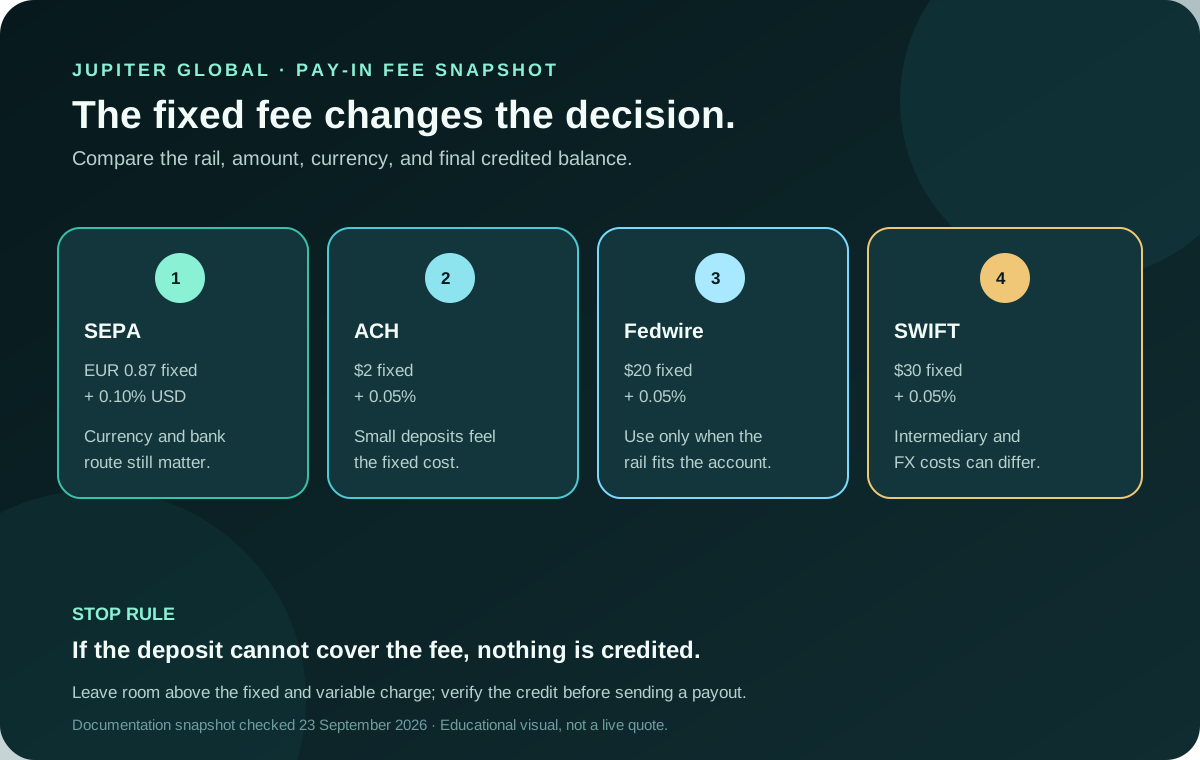
The published pay-in fees
The current Fees & Limits page lists these bank-funding inputs:
- SEPA: EUR 0.87 fixed plus 0.10% of the USD equivalent.
- ACH: $2 fixed plus 0.05%.
- Fedwire: $20 fixed plus 0.05%.
- SWIFT: $30 fixed plus 0.05%.
The fee is deducted from the amount credited. The figures are a documentation snapshot, not a live quote, and the product says fee structures may change. Current pay-in table
Fixed fees dominate small deposits
The percentage is not the whole cost. A $2 ACH charge is a large share of a small transfer, while the same fixed charge becomes less important on a larger valid deposit. Fedwire and SWIFT have higher fixed charges, so a small funding attempt can be economically weak even when the percentage looks low.
Jupiter’s documentation gives a stronger warning: if a deposit is too small to cover the rail’s fees, nothing is credited and the deposit is not refunded. Send enough to clear the fixed fee and variable fee with room to spare. Do not use a tiny transfer as an experiment on a rail with a meaningful fixed charge. Small-deposit warning
Choose by destination and account, not by label
Virtual accounts are bank details for incoming fiat. The remittance documentation says they are funded by incoming fiat transfers, while USDC cannot be deposited directly into a virtual account. That is a different path from sending USDC or USDT to a crypto deposit address. Virtual-account funding
SEPA, ACH, Fedwire, and SWIFT are not interchangeable in practice. Your bank, currency, account details, transfer purpose, and destination determine which rail is available. Read the receiving instructions shown for your verified Spend account and use the exact currency and beneficiary details supplied there.
A simple way to think about break-even
For a rail with fixed fee F and variable rate r, the approximate fee is:
fee = F + (r × transfer amount)
That formula helps you see why the fixed charge matters. It does not include your bank’s outgoing fee, correspondent-bank deductions, FX spread, or a route-specific hold. The final credited amount is the evidence that matters.
Use the site’s Quote Compare tool for a same-budget comparison only when you have current figures. Enter the total amount leaving your bank and the final amount expected in Spend; do not subtract a fee twice if the bank’s quote already includes it.
Separate funding fees from payout fees
The pay-in table applies to funding a virtual account. Outgoing local payouts and SWIFT transfers have a separate fee table. For example, the current page lists PHP and VND bank payouts at a $2.50 fixed fee plus 0.45%, while international USD SWIFT uses a $30 fixed fee plus 0.05%. Those are payout figures, not a reason to assume an incoming ACH or SEPA deposit costs the same. Payout fee table
The remittance service also has a separate $10,000 per-transfer limit, and the FAQ says a bank transfer has a $1 USD-equivalent minimum. Check both the route and the current in-app quote before funding. Transfer conditions
Protect the first funding attempt
Before sending:
1. Confirm you are in the official Jupiter Spend account and viewing the current virtual-account instructions. 2. Match the currency, beneficiary name, account number, and reference exactly. 3. Estimate the fixed and variable fee, then leave a sensible buffer above it. 4. Keep the bank receipt and transfer reference private. 5. Wait for the credit before planning an outgoing payment.
Do not send a second deposit because the first one is not visible immediately. Bank timing, intermediary checks, and account reconciliation are separate from the published fee table. If a transfer is delayed, use the original reference and official support rather than guessing at a new rail.
For a broader preparation sequence, read the USD and EUR virtual-account guide and the first international transfer checklist. The right rail is the one that is available to your account, clears the fixed-cost hurdle, and leaves a credited amount you can actually use.
Sources & what was checked
Public documentation reviewed 23 September 2026. This is a documentation-based guide, not a first-hand account, identity-verification or payment test. Open the current sources before acting.