Searching for Jupiter Global card prohibited countries can mean two different things: a country where a card cannot be issued to a resident, or a country where an existing card cannot be used for a purchase. Those are separate checks. A country may be acceptable for residence and still be prohibited for card spending while you travel.
There is also a documentation issue worth seeing clearly. Jupiter’s current Card documentation lists the countries where the card is actively offered, while the separate Jupiter Card Prohibitions List is dated January 23, 2026 and contains a stricter issuance and spending list. The two documents do not line up perfectly. That is a reason to pause and verify with the current app or official support, not a reason to treat either page as an automatic approval.
The short answer
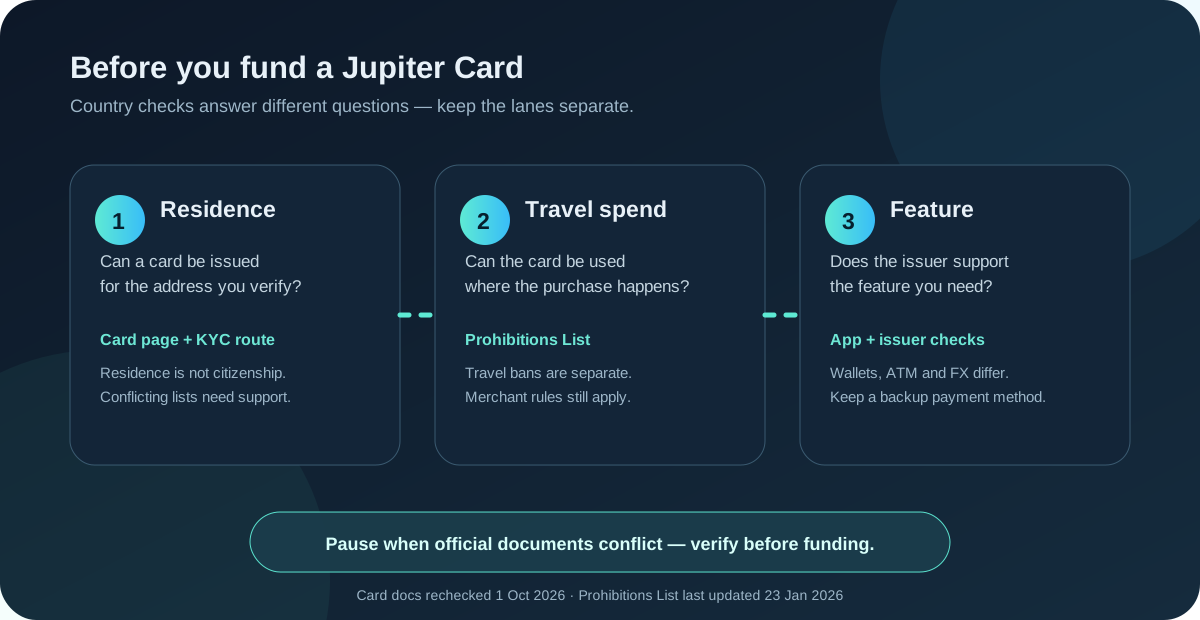
Use three questions in this order:
1. Can a card be issued for the residence you will verify? 2. Can the card be used in the country where the purchase happens? 3. Does the feature you need, such as a physical card, mobile wallet or withdrawal, work for that issuer and region?
Do not answer all three with a single “supported countries” list. Residence, travel spending, issuer assignment and feature availability have different conditions.
Countries named in the Prohibitions List
The dated Prohibitions List says Jupiter cards cannot be issued to cardholders residing or registered in these countries:
Belarus, mainland China, Cuba, India, Iran, Iraq, Israel, Myanmar, Nepal, Nicaragua, North Korea, Russia, Syria, Turkey, Ukraine, Venezuela and Vietnam.
It separately says that consumers residing in Nigeria or Sri Lanka may require enhanced review and explicit compliance approval. That is not the same as normal, automatic onboarding.
For spending, the same document names seven countries where Jupiter cards cannot be used, regardless of whether the cardholder is an individual or an entity:
Cuba, Iran, North Korea, Russia, Syria, Ukraine and Venezuela.
This distinction matters for travel. A person can have a card issued in a permitted residence and still be unable to use it in one of those destinations.
Why the lists need to be compared
The current Card page presents an active-offer list that includes Vietnam, while the dated Prohibitions List says cards cannot be issued to residents of Vietnam. It also says that a country not listed on the active Card page is reviewed case by case during KYC. These statements cannot be collapsed into one reliable yes-or-no database without knowing which rule is current for the account and issuer.
Treat the documents as evidence checkpoints:
| Check | What it can tell you | What it cannot prove |
|---|---|---|
| Current Card country page | Where Jupiter says the card is actively offered | That your KYC will be approved or that every feature is enabled |
| Prohibitions List | Explicit issuance, spending and enhanced-review exclusions | That an unlisted country is approved |
| App onboarding screen | The route currently presented for your residence | That a future travel transaction will settle |
| Official support response | Clarification for a specific case | A substitute for keeping the original written terms |
Save the page date and the exact wording when the decision affects a planned trip or a large deposit. Product documentation and partner rules can change.
Residence is not citizenship
Jupiter’s Card documentation says eligibility is based on country of residence, not citizenship. A passport from one country does not create an entitlement to use a different residence route. Use the address and proof-of-address information that actually applies to you, and do not select a relative’s address, a hotel, or a temporary location to force a country choice.
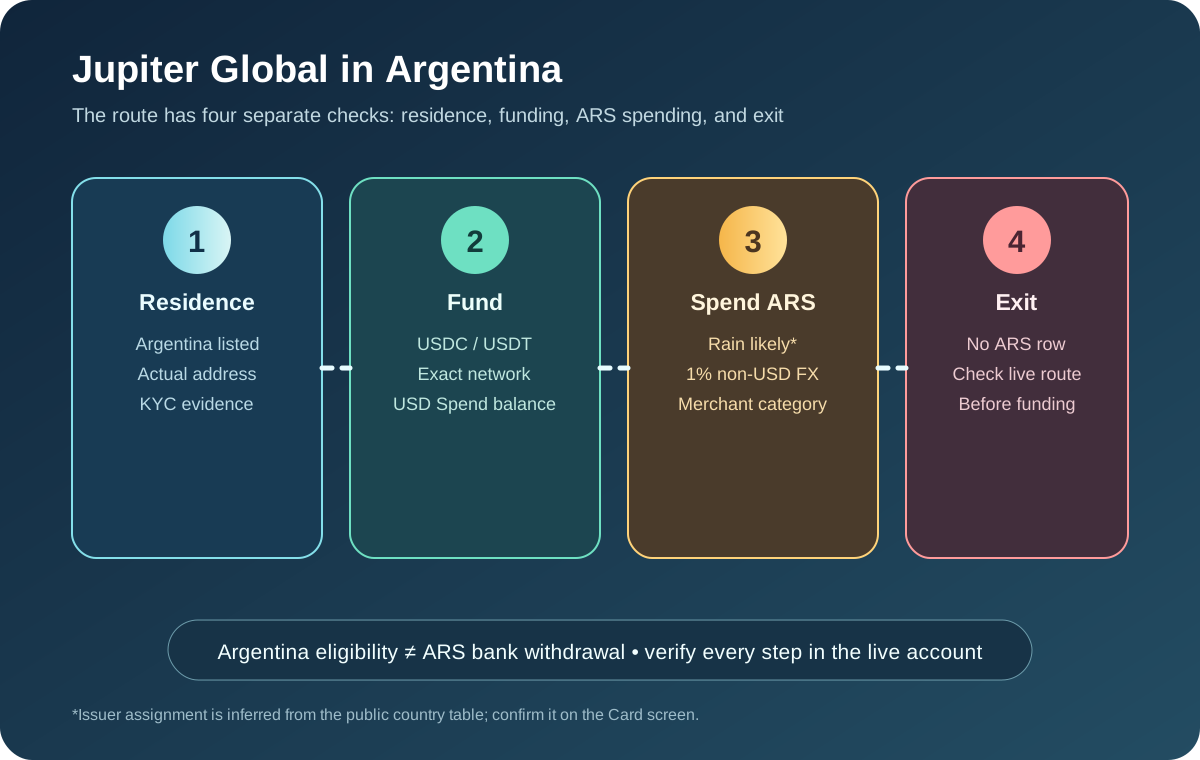
The same residence check may also determine whether the issuer is Rain or DCS, which can change the foreign-exchange fee and spending limits. A successful account screen is therefore only one checkpoint. Continue through the issuer, card type, balance, and feature screens before treating the route as usable.
Travel spending has its own risk
The Prohibitions List’s travel bans are geographic spending restrictions. They do not become permissible because a merchant displays a Visa logo, because the purchase is small, or because the card worked in another country. A decline at a prohibited destination is not a signal to retry repeatedly or to ask another person to present the card for you.
Other card controls can also matter while travelling:
- non-USD purchases may incur the issuer’s current foreign-exchange fee;
- a merchant category can be restricted even in a permitted country;
- Apple Pay or Google Pay availability depends on the region and wallet provider;
- withdrawals are region-dependent and are not universally available; and
- physical-card rollout, delivery and replacement are separate from virtual-card access.
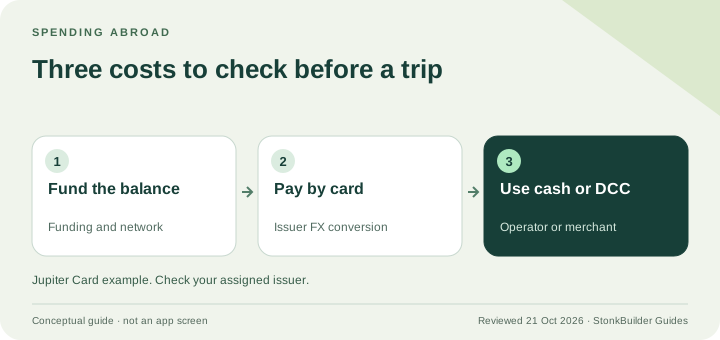
Read the restricted merchant guide when the destination is allowed but the type of purchase may be controlled. Read the card-abroad fee guide when the country is allowed but the currency is not USD.
A safer preflight before funding
1. Write down your actual residence and the destination country where the purchase will happen. 2. Check both the current Card page and the dated Prohibitions List. 3. Record any conflict instead of guessing which page wins. 4. Confirm the issuer, card type and available feature in the app after verification. 5. Check the merchant category, currency, FX fee and final amount. 6. Keep a separate payment method for travel-critical purchases. 7. Fund only after the route fits the documented conditions, and start with a modest ordinary purchase.
The supported-countries guide explains why card, QR Pay and bank-transfer geography cannot be merged into one list. Run the residence preflight, then use the first-payment checklist only for an ordinary merchant in an allowed route.
What this page cannot certify
A public document is not an account approval, and one successful purchase doesn’t prove that a future country or merchant will work. If the current app and public documents disagree, keep the evidence and ask official support before sending funds or relying on the card abroad. Never send a recovery phrase, private key, full card number or one-time code to someone offering to bypass a restriction.
If your residence and the country where you’ll spend both clear the current Card documentation and the dated Prohibitions List, run the residence preflight, then sign up for Jupiter Global. Finish verification and check the issuer, card type and destination controls before funding. Eligible Jupiter Card purchases earn 2% cashback, up to $100 a month.
Jupiter Global Card Prohibited Countries FAQ
Does a supported residence mean I can spend everywhere?
No. Residence issuance and travel spending are separate. The Prohibitions List names countries where spending is prohibited, and merchant-category or issuer controls can apply elsewhere.
Is Vietnam supported?
The current Card page lists Vietnam as an active offered country, while the dated Prohibitions List says cards cannot be issued to Vietnam residents. Because those official documents conflict, verify the live route with Jupiter before relying on it.
Can a VPN make a prohibited country work?
No. A VPN does not change residence, issuer rules, sanctions or merchant location. Do not misstate your address or attempt to bypass a geographic restriction.
Does a Visa logo mean a Jupiter Card purchase is allowed?
No. Merchant acceptance does not override a geographic spending ban, issuer control, restricted category or account-specific decision. Check the destination, merchant type and current Card rules before relying on a payment.
What should I do when Jupiter’s country documents conflict?
Save the dates and exact wording, compare the current Card page with the dated Prohibitions List, and ask official support about your residence and intended destination. Do not fund or travel on the assumption that the more convenient interpretation is current.
Sources
Checked against these sources on 1 October 2026.