The Jupiter Card FAQ says Visa protections can allow a cardholder to dispute a fraudulent transaction or a charge where a merchant fails to deliver. That is a route to an issuer review, not a promise that every claim will be approved or refunded. The useful first step is to identify the transaction state and assemble a private, traceable record before contacting the issuer assigned to your account.
Jup Global Community is an independent learning site published by StonkBuilder.
Chargeback is not the same as a refund
A merchant refund is a payment the merchant agrees to send back. A chargeback or dispute is an issuer review of a card transaction under the card network’s process. A support ticket acknowledgement only proves that a request was received. It does not prove that a dispute was accepted, a refund was ordered, or the amount will return to your balance.
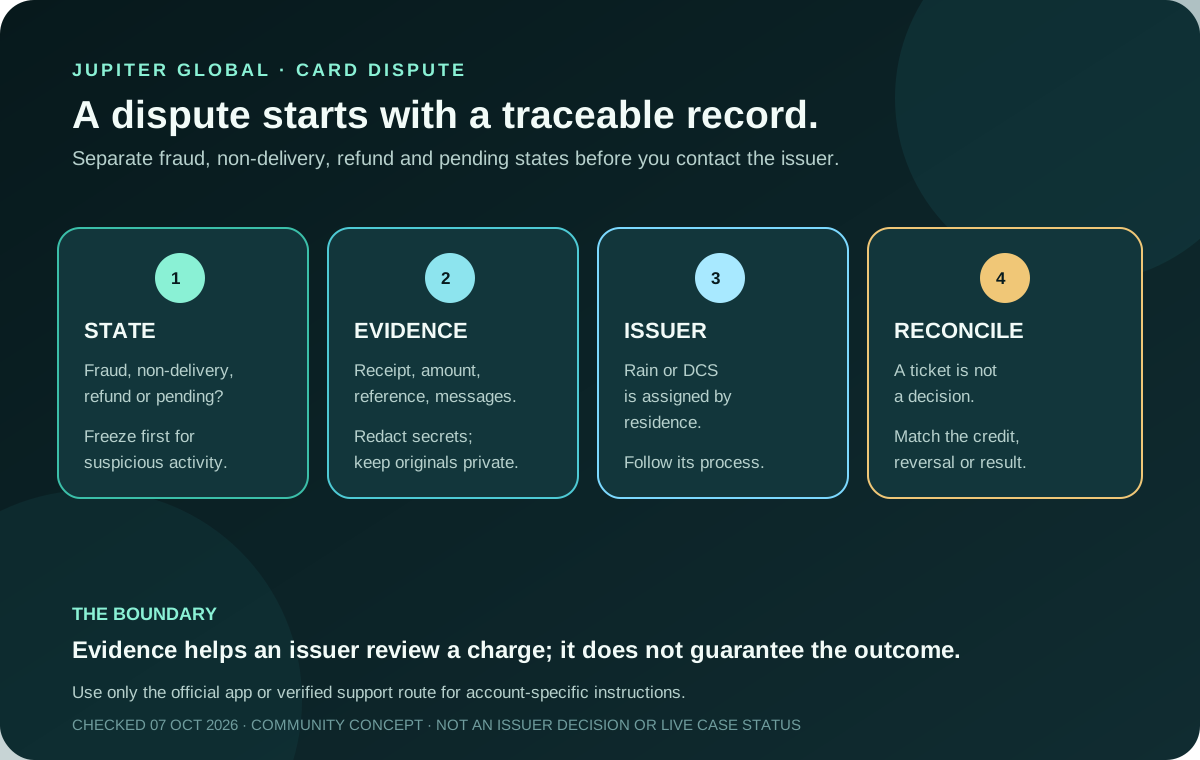
Jupiter’s FAQ describes the Card as operating on Visa and says disputes can be raised through the assigned issuer, Rain or DCS. The issuer is based on country of residence. Follow the instructions shown in the official app or verified support route for your account; do not copy a process from another country or another issuer. Current dispute and security guidance · Card issuer details
First name the problem
Before asking for a chargeback, classify the last confirmed state:
- Unrecognised or fraudulent: freeze the card immediately in the app, then use the official issuer or support route.
- Merchant did not deliver: keep the order, promised delivery, cancellation and merchant-contact records together.
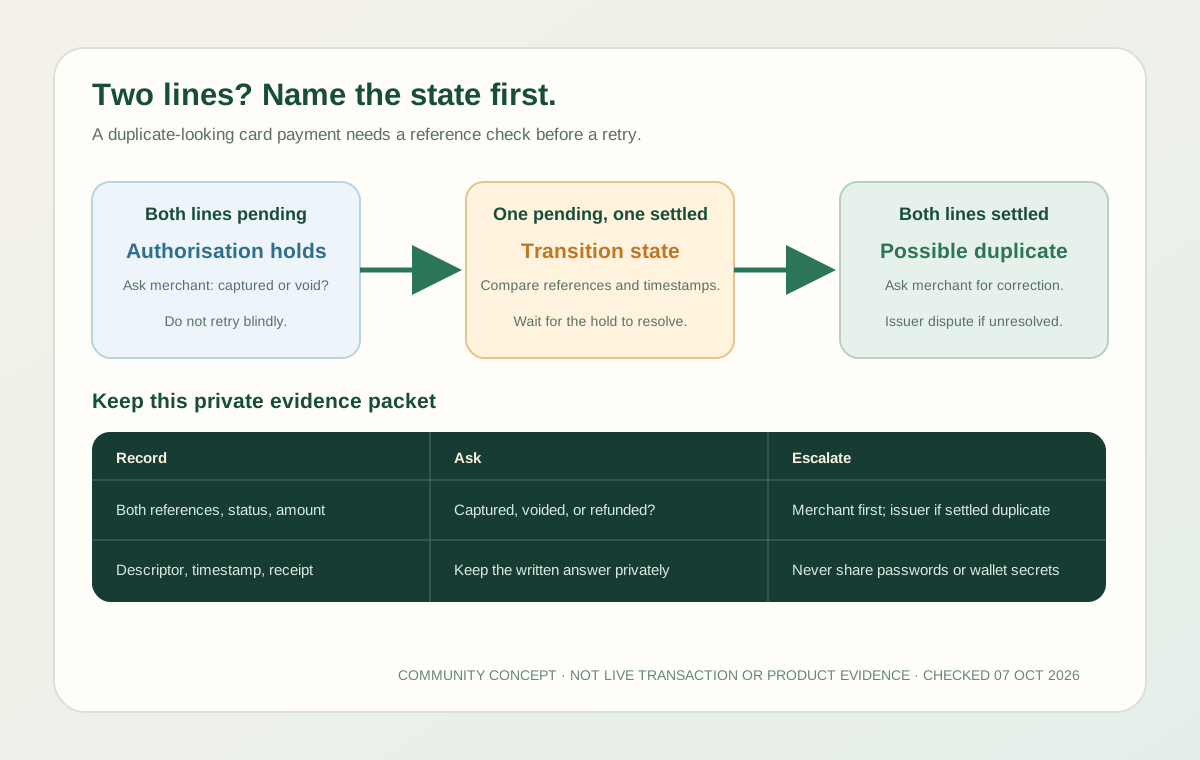
- Pending authorisation: the merchant may not have captured the amount. A pending hold is not automatically a settled charge or a completed fraud claim.
- Refund promised: compare the merchant’s refund confirmation with the card history. A settled refund can take up to seven business days, and a pending authorisation can follow a different release path. Refund timeline
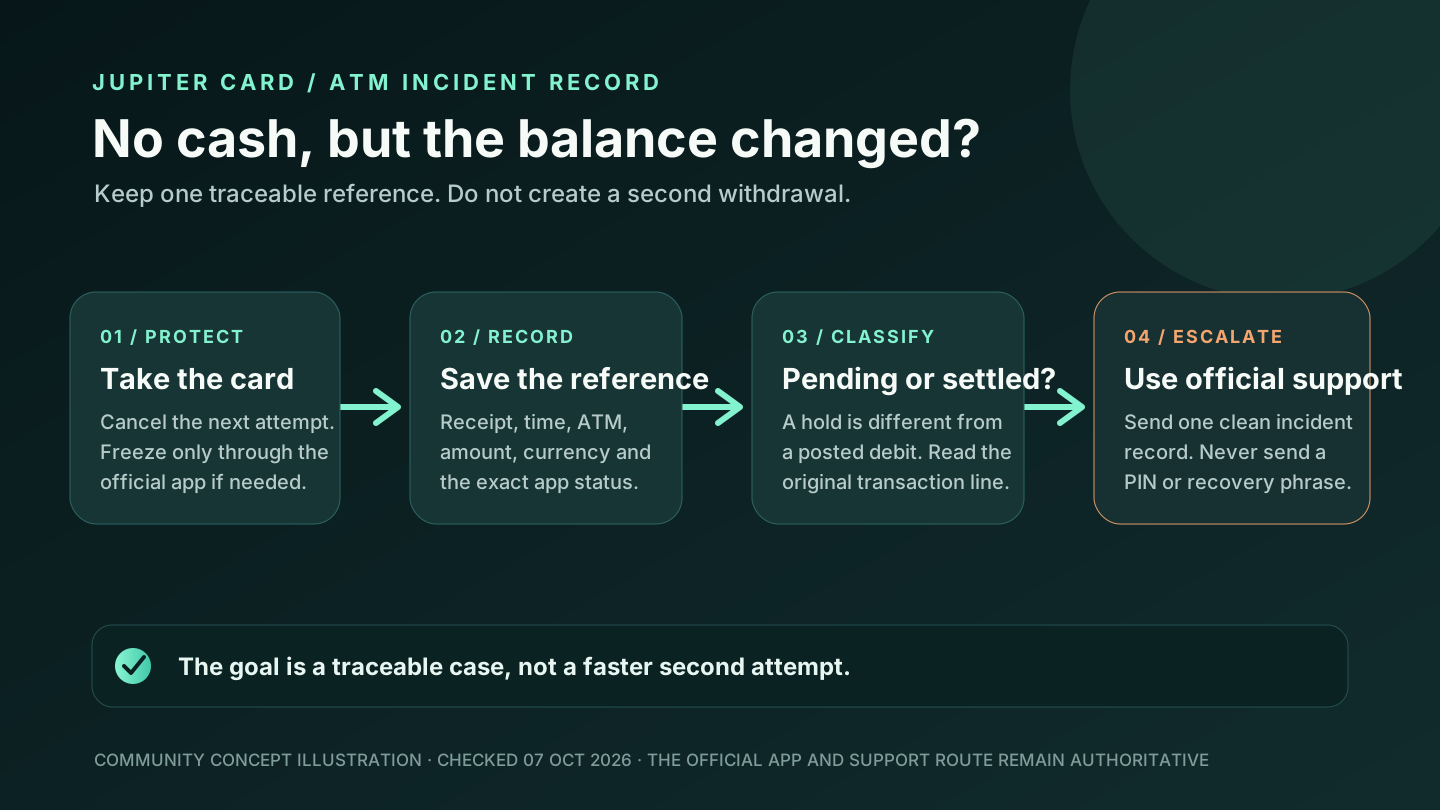
The distinction prevents a common mistake: opening the wrong recovery path while a legitimate authorisation is still unresolved. If the merchant says a payment failed but the app still shows it pending, do not create a duplicate payment just to make the original line disappear. Use the payment-status guide first.
Build a private evidence packet
An issuer needs a clear story that can be tied to one transaction. Keep these items together privately:
1. Merchant name and the exact descriptor shown in the card history. 2. Amount, currency, date, time zone and transaction reference. 3. Order number, invoice or checkout confirmation. 4. What the merchant promised, including the delivery or service date. 5. Your attempts to resolve the issue, with dates and the merchant’s replies. 6. Cancellation, refund or non-delivery evidence, if applicable. 7. The result you expected and what the card history actually shows.
Redact passwords, one-time codes, full card numbers, identity documents, recovery phrases and private keys. A screenshot with secrets visible is not stronger evidence; it creates another security problem. Jupiter’s risk guidance says Spend products rely on regulated partners and that partner terms and availability apply. Partner and security risks
Merchant non-delivery has its own order
For a purchase you authorised but did not receive, contact the merchant through its verified channel and ask for a specific resolution: delivery proof, cancellation, or a refund reference. Keep the request factual and set a private reminder to follow up. Do not let a merchant’s promise erase the original card reference.
If the merchant does not resolve the issue, use the issuer’s dispute process promptly and supply the evidence packet. The issuer and card-network rules set the deadline, the required form and the decision standard. Ask the official channel what additional evidence or timing rule applies to your account.
For suspected fraud, the order changes: freeze first, then contact the issuer. Do not wait for a merchant reply when you did not authorise the transaction. The lost-card and suspicious-activity guide covers that path separately.
What happens while the review is open
Keep the original transaction reference attached to every message. Do not make a second payment because a case is open, and do not assume a frozen card cancels a settled charge. A frozen card blocks further use; it does not itself file a dispute or guarantee reimbursement.
Check the app for a posted credit, reversal or updated status. If a refund is issued after a non-USD payment has settled, Jupiter’s Card documentation says the refund uses the FX rate on the day it is issued and the original FX fee is not refunded. Compare the original currency, refund date and credited amount before concluding that the result is missing. Refund and FX details
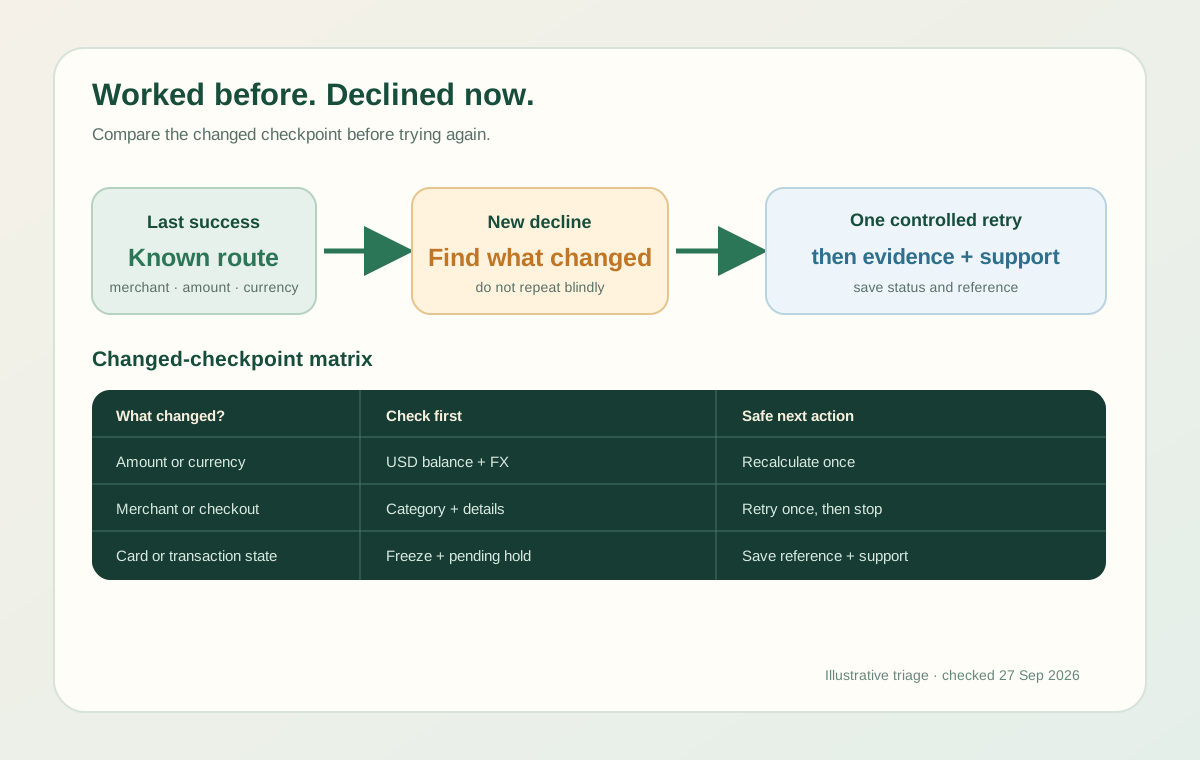
If the dispute concerns a merchant category that the fee table restricts, the issuer may apply additional compliance or risk review. The current table lists categories that can be automatically declined and says some merchants may be dynamically restricted. That is another reason to preserve the exact descriptor rather than describing the merchant only by its brand name. Merchant-category rules
A compact dispute checklist
| Checkpoint | Keep | Do not assume |
|---|---|---|
| State | Pending, settled, reversed or unknown | A pending line is a completed debit |
| Merchant case | Order, promise, replies, refund reference | “We refunded it” means the balance has posted |
| Issuer | Rain or DCS and the official route | Another country’s process applies to you |
| Security | Redacted records and original references | A stranger can speed up a dispute |
| Result | Credit, reversal, case reference or decision | A ticket acknowledgement is approval |
Use Safety Practice to rehearse the freeze, evidence and support boundaries without entering card or identity details.
If you already have an unresolved charge, use the official app or Jupiter Support Hub rather than relying on a community promise. If the card fits your use case, sign up for Jupiter Global after checking supported residence, assigned issuer, verification state, balance and the ordinary first-payment route. Once you’re signed up, eligible card spending earns 2% cashback, up to $100 a month.
Aim for a correctly classified transaction, a private evidence packet and an issuer case that can trace the original reference. The decision remains with the issuer; the quality of your record is what you can control.
Jupiter Global card chargeback FAQ
Is a chargeback the same as a merchant refund?
No. A merchant refund is a payment the merchant agrees to send back. A chargeback or dispute is an issuer review under the card-network process, and neither a support ticket nor a merchant promise proves that money will be returned.
When should I freeze the card?
Freeze it immediately through the official app when a transaction is unrecognised or appears fraudulent, then use the assigned issuer or verified support route. A freeze blocks further card use but does not reverse a settled charge.
Can I dispute a pending authorisation?
First classify the state. A pending authorisation may not have been captured and can follow a release path different from a settled dispute. Keep the reference and use the payment-status guidance before opening the wrong recovery route.
What evidence should I keep for a merchant non-delivery dispute?
Keep the descriptor, amount, currency, date, transaction reference, order or invoice, promised delivery date, merchant replies, cancellation or refund records, and the result you expected. Store the packet privately and redact secrets.
Does a chargeback guarantee a refund?
No. The assigned issuer decides the case under its process and may request additional evidence or timing details. A case acknowledgement proves receipt only; it does not prove approval or reimbursement.
Sources
Checked against these sources on 7 October 2026.