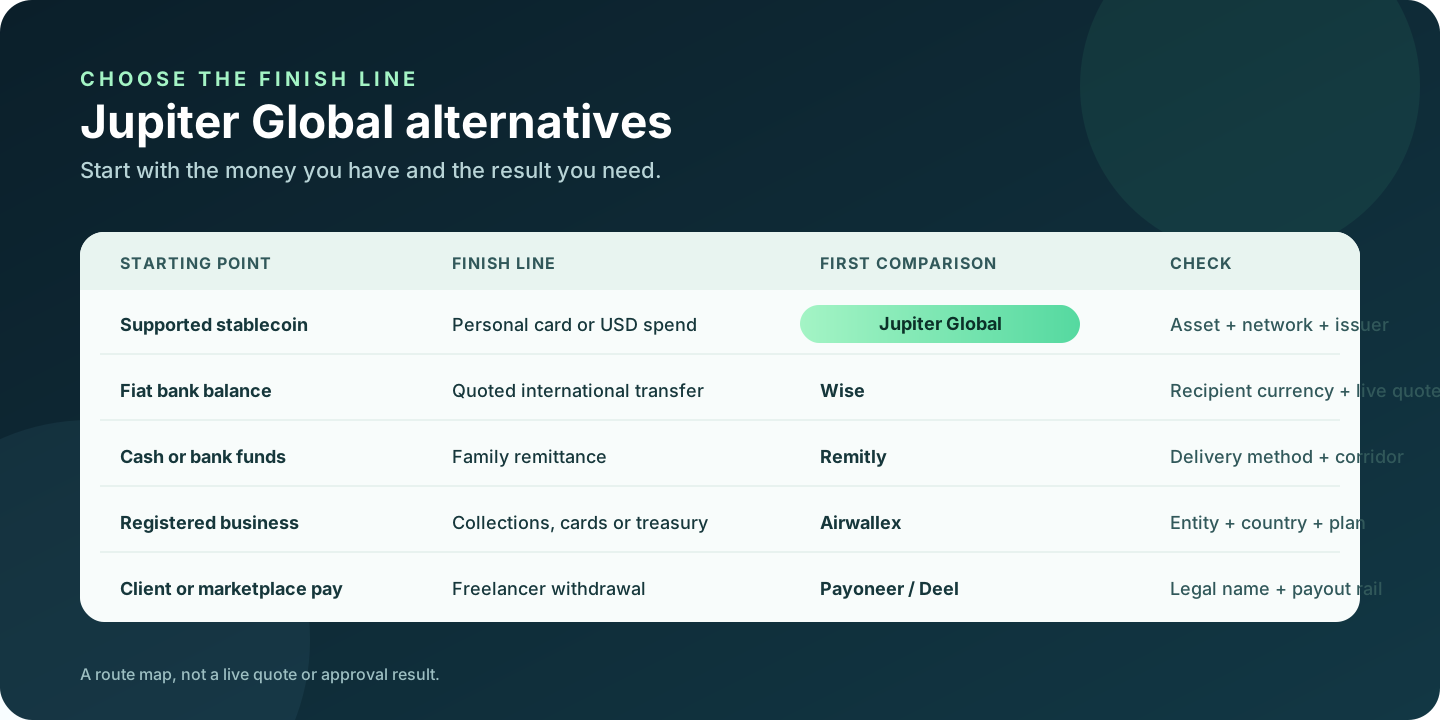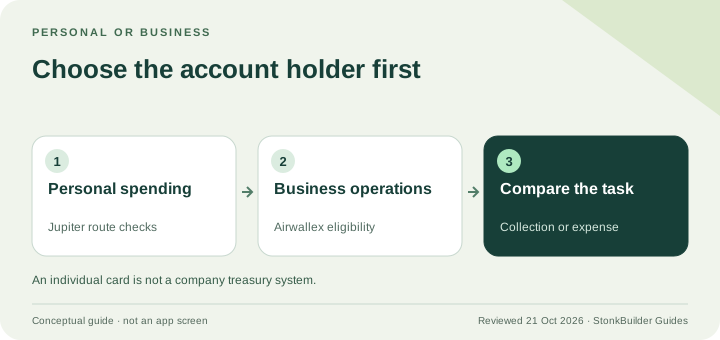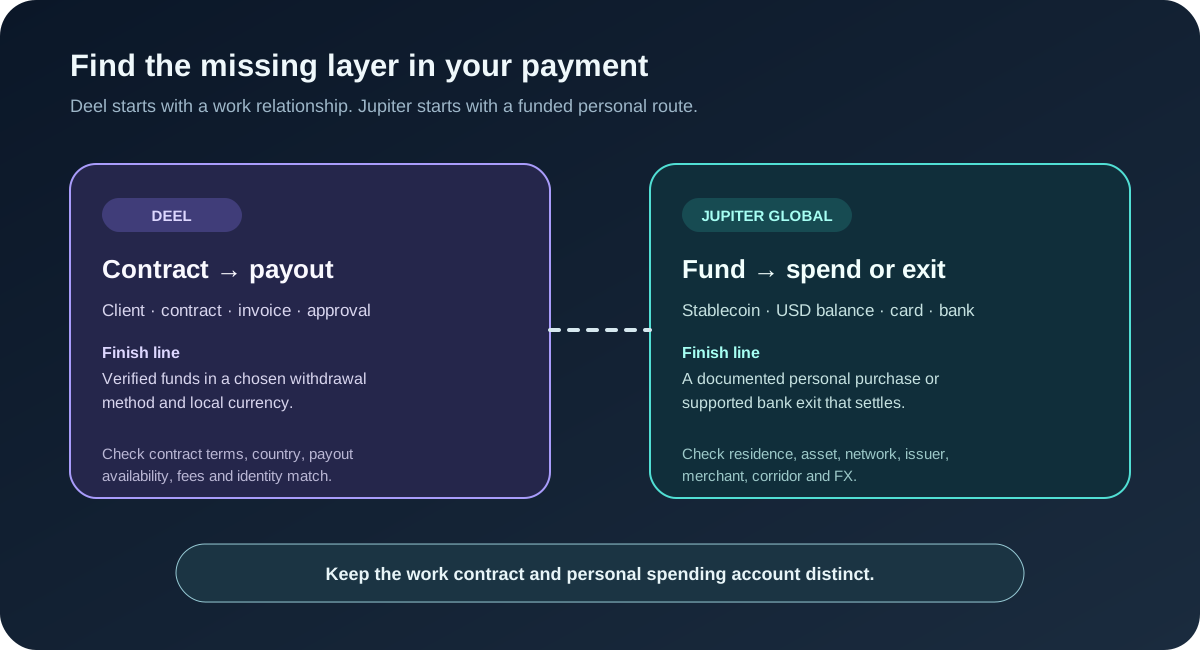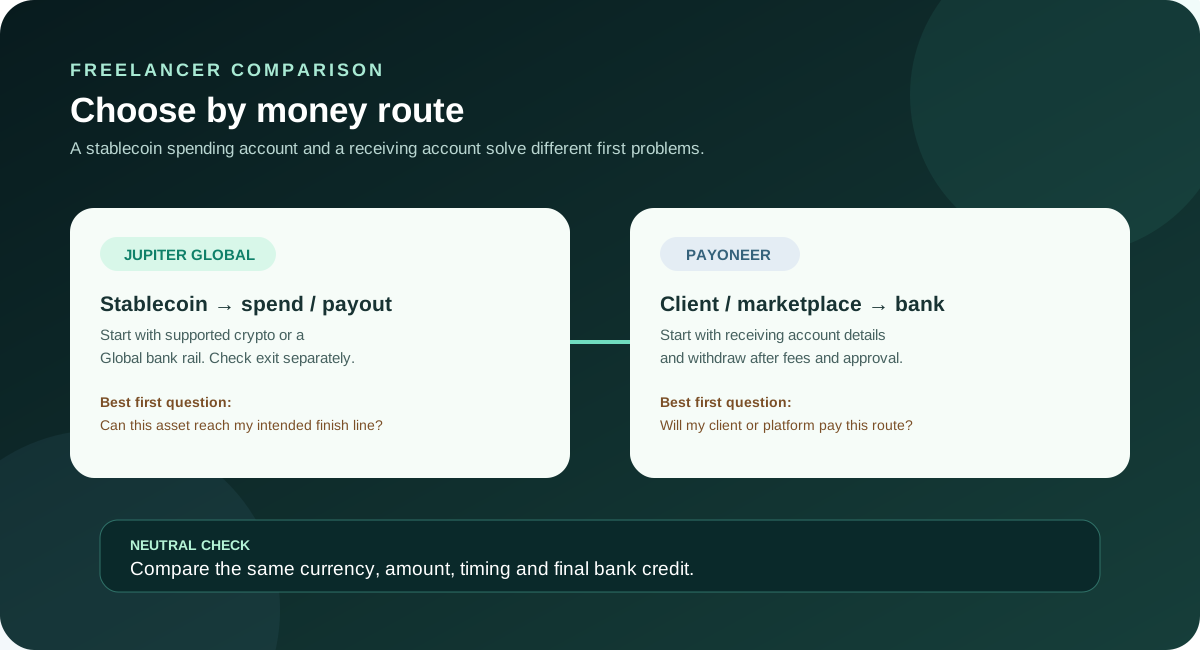
If you are a freelancer comparing Jupiter Global vs Payoneer, start with the payment you need to finish. The two products overlap around international money, but they are built around different starting points. Jupiter Global connects a stablecoin-funded Spend balance, card use and selected fiat routes. Payoneer is built around receiving business payments, marketplace payouts and withdrawing a balance to a local bank. Jupiter Spend overview · Payoneer receiving accounts
The short answer
Choose the route that matches how you’re paid and where the money needs to go:
| If your main job is… | The first product to investigate | Why |
|---|---|---|
| Spend supported stablecoins on USD-priced work tools | Jupiter Global | The documented Spend flow turns supported deposits into a USD balance for card use. |
| Receive client or marketplace payments by bank rail | Payoneer | Its receiving-account product is designed for clients, platforms and local account details. |
| Receive fiat, then use a virtual card or local payout | Compare both | Account, country, currency and business-use rules decide the route. |
| Send a large or recurring business payment | Neither by headline alone | Compare the exact quote, beneficiary rules, limits, compliance and support path. |
This is a route comparison, not an approval result or a promise that either provider supports your client, platform or residence.
What Jupiter Global is good at
Jupiter Global is a strong candidate when your money already begins as a supported stablecoin or when you want one verified account to investigate for card spending and fiat remittance. The current documentation describes USD, GBP and EUR virtual accounts, SWIFT transfers and local payouts, with availability depending on verification, residence, corridor and the live account flow. Global Fiat Remittance
For a freelancer, its practical strengths are:
- Stablecoin-to-spend: the FAQ documents USDC on Solana, Ethereum, Sui, Arbitrum or Base, and USDT on Solana for the Spend deposit flow. The asset and network must match exactly. Jupiter Spend FAQ
- USD work expenses: a USD-priced subscription or supplier payment can fit the card route, subject to the assigned issuer, balance and merchant rules. Non-USD card spend can carry the issuer’s current FX fee. Jupiter Card · Spend fees
- One route to investigate: card spending, bank rails and local payouts can sit under the same Global account, but each feature still has its own eligibility and evidence checks.
Its limits matter just as much. A successful stablecoin deposit does not prove that a fiat withdrawal is available. A card approval does not prove that a local payout corridor is open. The current app and official documentation must decide the route.
What Payoneer is good at
Payoneer’s receiving-account product is designed around getting paid by clients, marketplaces and networks. Its official page describes local account details in selected currencies, incoming local transfers and SWIFT receiving routes, plus holding, conversion and withdrawal to a local bank. Availability, currencies, approval and fees vary by account and country. Payoneer receiving accounts
For a freelancer, that makes Payoneer worth checking when:
- a client wants familiar local bank details instead of a crypto address;
- a marketplace or platform already supports Payoneer as a payout method;
- you need a business-oriented receiving workflow before withdrawing to your local bank; or
- your primary problem is collecting invoices rather than spending stablecoins.
The public pricing page also shows that fees depend on the payment method and account. Card payments, ACH debits, marketplace payouts and receiving accounts do not have one universal price. Use the fee schedule shown for your account instead of copying a number from another country. Payoneer pricing
Compare the route, not the logo
Use the same questions for both products:
1. How does the client pay? Bank transfer, marketplace payout, payment request and stablecoin deposit are different rails. 2. Who is the beneficiary? Check whether the account name and business details meet the client or platform’s requirements. 3. What balance do you receive? Record the currency, arrival amount and any conversion before comparing withdrawal costs. 4. Where does the money finish? Card purchase, supplier payment and local bank credit need separate evidence. 5. What happens when the route pauses? Save the reference, timestamp, quote and official support path without sharing private keys or one-time codes.
The freelancer route guide explains Jupiter’s money-in and money-out checkpoints. The Route Finder helps choose the next documented path, while Quote Compare lets you compare the total debit and final usable amount.
Three realistic freelancer scenarios
A designer paid in USDC who buys software in USD
Jupiter Global may fit when you start in USDC and want to spend it. Check the exact network, make a modest deposit, confirm the USD balance, and test one ordinary subscription before moving a critical renewal. Payoneer solves a different problem unless the client or marketplace requires its receiving account.
A developer paid by a marketplace in USD
Payoneer may be the first route to investigate if the marketplace lists it as a payout method. Confirm the receiving account, marketplace fees, conversion rate and local withdrawal before accepting the job. Jupiter Global may still be useful for separate stablecoin spending, but do not assume the marketplace will pay a virtual account without checking its policy.
A consultant who needs USD income and local-currency expenses
Compare the complete path. A USD virtual account, conversion and bank withdrawal can have a different total cost from a stablecoin deposit, card purchase and local payout. Enter the same source amount, destination currency and timing into a quote comparison; do not compare a zero headline fee with an unquoted exchange rate.
When to pause
Pause if someone asks for your recovery phrase, private key, card security code or one-time login code. Pause if the beneficiary name, currency or network differs from the invoice or receiving instructions. Pause if a provider shows a pending status and you are about to repeat the payment. Official support and the current in-app route are the right evidence sources. Risks and security
Which should you choose?
Use Payoneer first when the job begins with a client or marketplace bank payout and you need business-oriented receiving details. Investigate Jupiter Global first when the job begins with supported stablecoins and ends with USD card spending or a documented Global payout route. If you need both, keep the decision separate: one account can receive income while another handles a specific spending or conversion job.
If Jupiter’s route fits your work, read the official app-download guide first, then sign up for Jupiter Global and check the live eligibility, fee and corridor screens before moving money. When you spend on the card, eligible Jupiter Card purchases earn 2% cashback, up to $100 a month.
Jupiter Global vs Payoneer FAQ
Is Jupiter Global or Payoneer better for freelancers?
Payoneer is the first route to investigate when a client or marketplace needs receiving-account details and a local bank withdrawal. Jupiter is the first route to investigate when supported stablecoins are the starting balance and you want to end up with personal card spending or a documented Global payout.
Can a client pay a Jupiter Global virtual account directly?
Do not assume it. Confirm that the client or marketplace accepts the exact account type, currency, beneficiary name and receiving rail shown in the current Jupiter app. A virtual account is not automatically accepted by every payer.
Can Payoneer replace a stablecoin-funded card?
Not automatically. Payoneer’s receiving workflow and Jupiter’s Spend card solve different jobs. Compare where the money starts, how it arrives, what balance you receive and the final purchase or withdrawal you need.
How should I compare their fees?
Use the same source amount, currency, recipient, conversion, withdrawal method and timing. Include marketplace or client charges, conversion spreads, payout fees and the final usable amount instead of comparing one headline fee.
What should I verify before accepting a client payment?
Confirm the legal beneficiary, supported currency, receiving details, account status, expected timing and support route. Keep a private reference packet and never share passwords, one-time codes, recovery phrases or private keys.
Sources
Checked against these sources on 7 October 2026.