If you search for Jupiter Global vs Deel, you may be trying to solve one of two different problems: getting paid for work, or using a stablecoin-funded balance after the money is yours. Jupiter Global and Deel can appear in the same remote-work conversation, but they sit at different points in the payment chain.
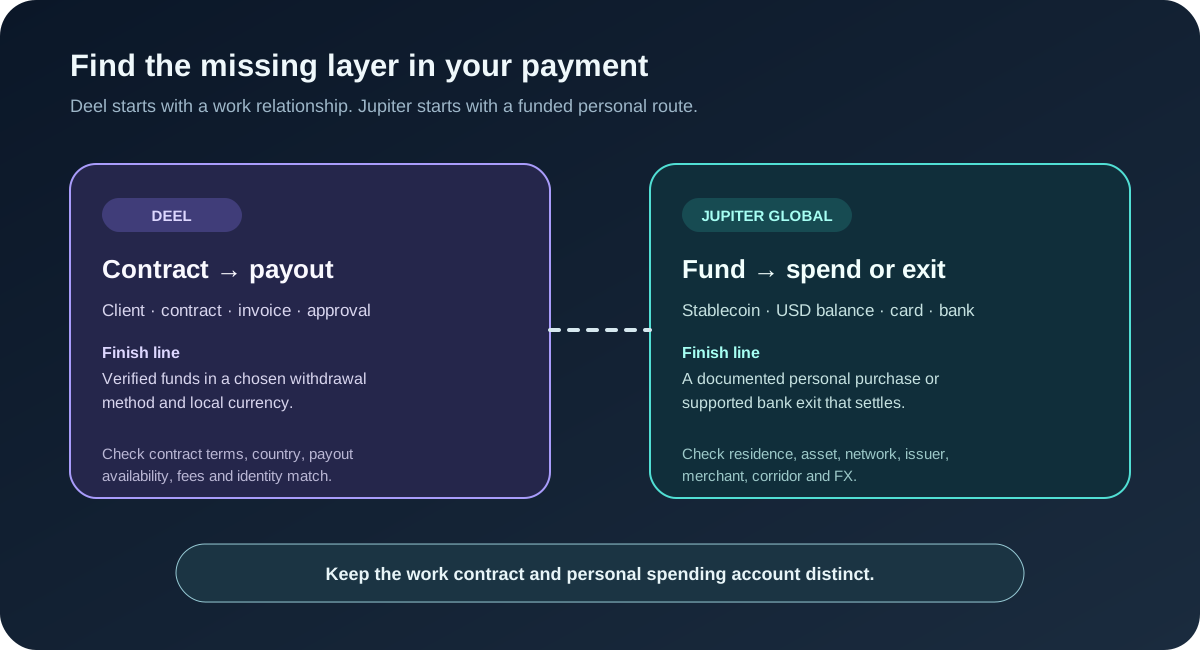
Deel is a contractor and workforce platform. Its official contractor pages describe contracts, invoices, compliance workflows, payment approvals and global payouts. Jupiter Global documents a personal Global account with a USD Spend balance, card spending, stablecoin funding and selected fiat routes. Deel contractor workflow · Jupiter Spend overview
The short answer
- Your client needs a contract, invoice, approval and payout workflow: Deel is the relevant route to investigate.
- You already hold supported stablecoins and want to spend or exit personally: Jupiter Global is the closer route to investigate.
- You are a contractor paid through Deel and want to use stablecoins afterward: the products may be complementary, but the withdrawal method, currency, identity and local rules still need checking.
- You are building payroll or managing several contractors: Jupiter Global is not documented as a replacement for Deel’s contracts, classification safeguards or workforce controls.
- You need a card for ordinary personal spending: compare Jupiter’s residence, issuer, merchant, FX and funding conditions instead of choosing a contractor platform by its card headline.
The useful comparison is the complete route: who pays, who holds the balance, what documentation is created, how the money exits, and what you need to prove if a payment is delayed.
The first boundary: who is the account for?
Deel’s contractor-account guide lets a worker sign up as an individual contractor or through an entity. It asks for personal details, address and tax residency, and says identity verification is required before withdrawing funds. Deel contractor account
Jupiter Global begins with your residence and Jupiter ID verification. Its Card documentation says the card is assigned through an issuer based on country of residence, and the Spend balance is separate from a bank account or a generic crypto wallet. A supported residence narrows the question; it does not prove that every card, payout, QR or withdrawal feature will appear in your account. Jupiter Card · Jupiter risks
This creates a simple test:
| Question | Deel | Jupiter Global |
|---|---|---|
| Who starts the payment? | A client or company through a contract | You, an external bank, or a supported crypto funding route |
| What is the first object? | Contract, invoice or approved work | Verified Global account and Spend balance |
| Who is the main user? | Contractor, client, HR or payroll operator | Individual account holder |
| What does the card represent? | A possible contractor payout or spending method | A USD Spend balance funded through documented routes |
| What is the key risk? | Wrong contract, payout method, identity or local compliance detail | Wrong residence, asset, network, issuer, merchant or bank-exit assumption |
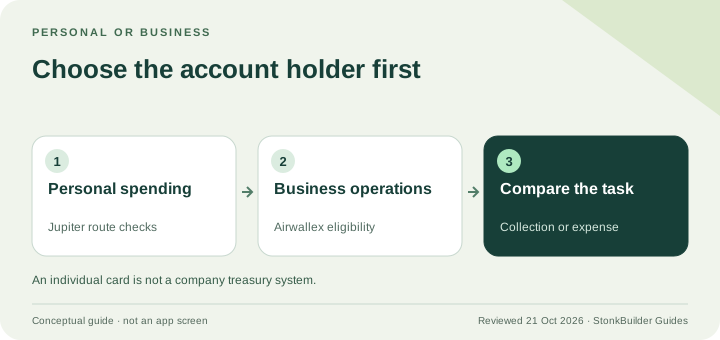
Do not treat a successful Deel contract as proof that a Jupiter card can receive that payment directly. Do not treat a Jupiter card as proof that a client has created a compliant contractor relationship.
Getting paid through Deel
Deel describes a workflow where the client creates a contract, the contractor signs it, invoices or milestones are approved, and funds become available in the Deel Balance on the contract’s payday. Contractors can then request a withdrawal or set up automatic withdrawal. The account guide says withdrawal timing depends on the selected method and can range from seconds to seven business days, with SWIFT taking five to seven business days in the documented example.
The contractor-management page also describes local-currency payouts, multiple payment options, compliance safeguards and a contractor portal for documents, invoices and payment tracking. Deel publishes broad coverage claims, but the actual withdrawal method and currency remain account- and country-dependent. Deel contractor management
This is useful when your main problem is how a company pays you. It is also why Deel should not be compared with Jupiter solely on card acceptance or FX. Deel is solving the payer-to-contractor workflow before the money reaches your chosen withdrawal method.
Spending and exiting through Jupiter Global
Jupiter’s documentation describes a different sequence: complete Jupiter ID verification, fund the Global account through a supported route, hold a USD Spend balance, then use the card or a documented fiat route. USDC and USDT support, network rules, issuer assignment, bank payouts and local corridor availability must be checked independently. Jupiter remittance · Jupiter fees
That makes Jupiter potentially useful after income has already reached a supported asset or bank route. It does not make the card a payroll system, invoice manager or proof that a client’s payment is received. The final amount, bank credit and withdrawal route remain separate checkpoints.
Withdrawal methods are the real comparison
Deel’s current withdrawal documentation lists bank transfer, Wise, PayPal, Payoneer, Revolut, Coinbase, digital currency including USDC and USDT, and other methods. It warns that not every method is available in every jurisdiction, that the name and billing address must match, and that fees depend on the method. It also lists examples such as local bank transfers, cross-border withdrawals, SWIFT, instant card transfer and crypto-specific fees. Deel withdrawal methods
Jupiter’s route has a different asset boundary. Its current fee and remittance documentation distinguishes the Spend balance from withdrawal routes, makes the USDC-versus-USDT exit important, and says country, issuer and corridor conditions apply. A person who receives USDC from Deel still needs to decide whether sending that asset into Jupiter is supported and whether the intended bank exit is available afterward.
Use this checklist before comparing a headline fee:
1. Is the payment arriving as fiat, USDC, USDT or another asset? 2. Is the recipient account personal or an entity account? 3. Does the chosen method support your country and exact currency? 4. Is the fee fixed, percentage-based, FX-based or embedded in the route? 5. Does the money need to reach a bank, a card balance, a wallet or a merchant? 6. What evidence will your bank, tax authority, client or support team need if the payment is held?
The site’s quote comparison tool can compare amounts you enter. It cannot fetch Deel or Jupiter quotes, decide tax treatment, or verify an account.
Who should choose which route?
A freelancer with one international client
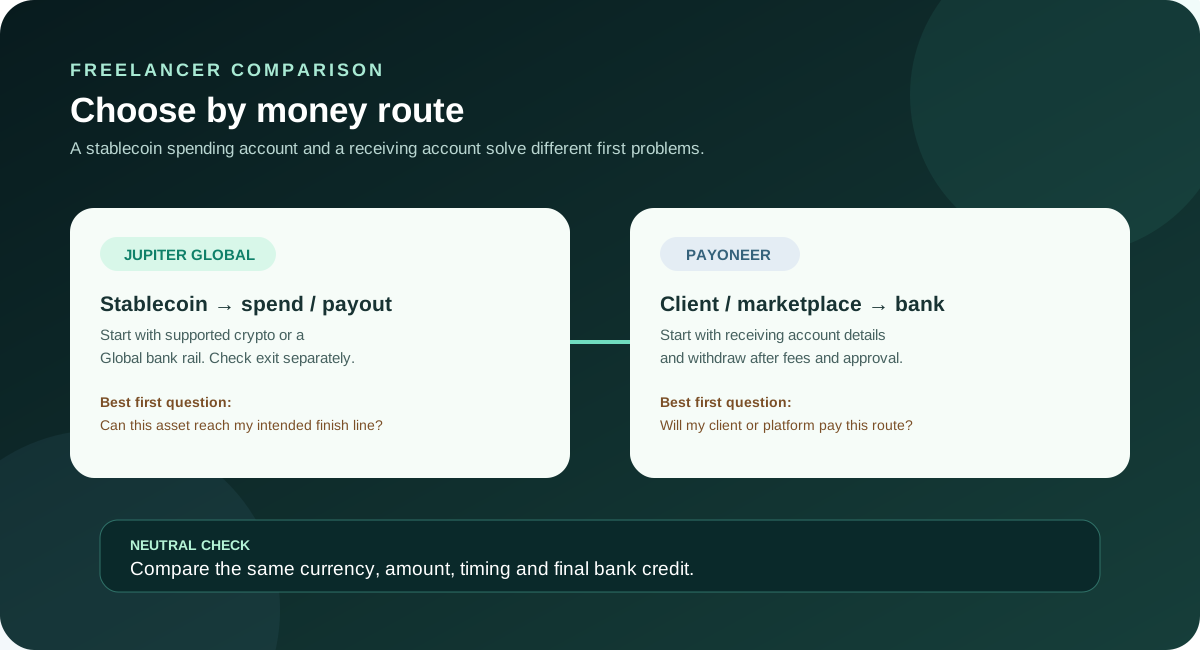
If the client wants a contract, invoices, approvals and a documented payout process, start with Deel’s contractor route. If the client already pays you through another method and your next need is personal stablecoin spending, investigate Jupiter separately. Keep the work contract and the spending account conceptually distinct.
A crypto-native independent worker
Jupiter may fit the spending side when you already hold a supported stablecoin, understand the network rule and have a documented local exit. Deel may still be the payer-side tool if a client requires a contract and invoice workflow. Do not send an unsupported token or assume a client’s payroll platform can fund a card directly.
A company paying a distributed team
Deel’s contractor and compliance workflow is the relevant starting point for contracts, classification, approvals and bulk payouts. A personal Jupiter account should not be used as the company’s payroll ledger or as a substitute for local employment and contractor rules.
A remote worker who only wants a card
Start with Jupiter’s residence and card checks, then inspect issuer, FX, merchant restrictions, prohibited countries and the funding asset. Deel’s contractor card may be useful only if you are eligible through a Deel payment workflow and its local withdrawal terms fit your account.
A five-minute decision sequence
1. Identify the payer and the reason for payment. 2. Decide whether you need a contract-and-payout layer or a personal spending-and-exit layer. 3. Write down the legal account holder, residence, source asset, amount and destination. 4. Check the exact withdrawal method and currency in the live provider screen. 5. Compare total cost, timing, documentation and reversibility. 6. Use a small, traceable first route and keep a backup method until it settles.
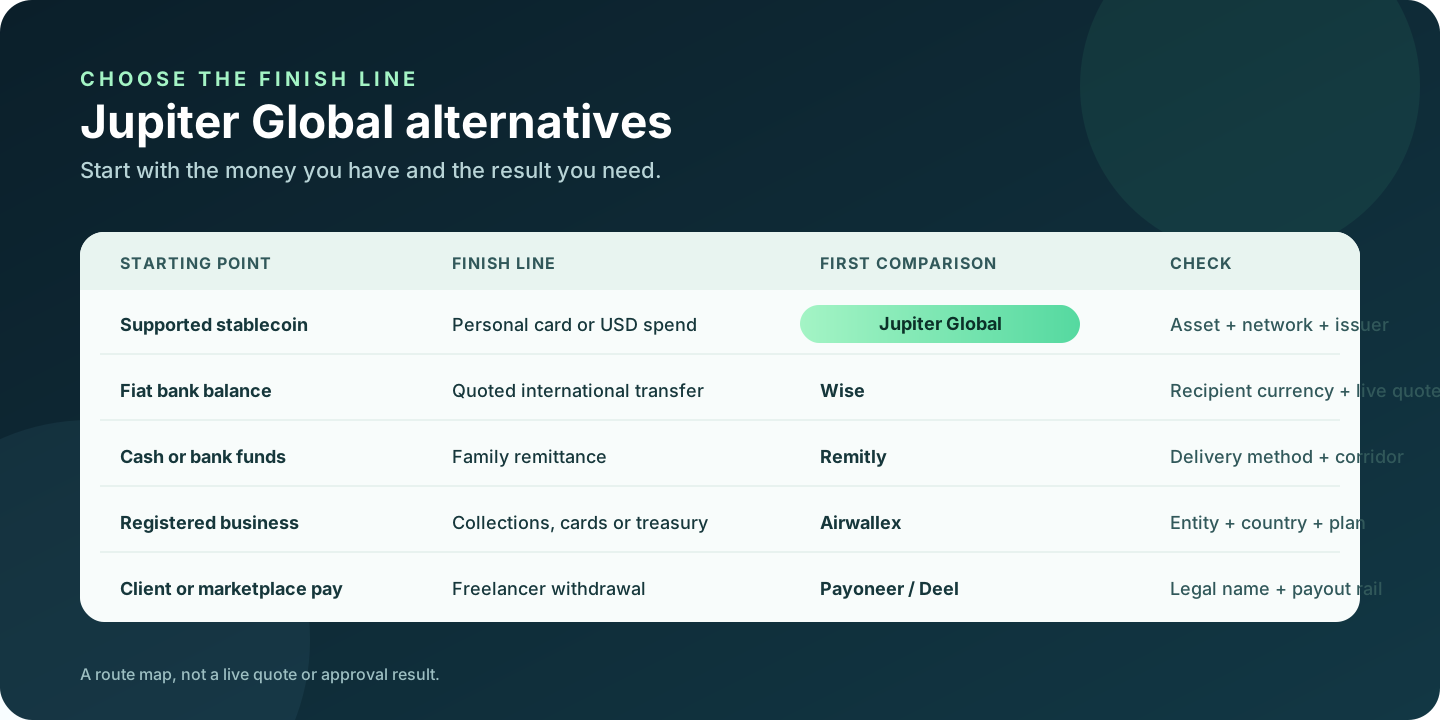
Read the Jupiter Global freelancer guide for stablecoin, card and bank-exit decisions, and the Airwallex comparison when your main question is a registered-business treasury account.
What you still need to check yourself
Your worker classification, tax position, account approval, live quotes and local withdrawal options all depend on your own situation, and no comparison can settle them for you. Contractor payments can carry legal, tax and reporting obligations, so rely on your contract, local rules and the current provider screens.
A sensible setup keeps the two apart: Deel for the contract and payout workflow when the payer requires it, and Jupiter Global for personal stablecoin spending or a documented exit route when that’s what you need. If Jupiter covers your side of it, sign up here and you’ll earn 2% cashback on eligible Jupiter Card purchases, up to $100 a month.
Jupiter Global vs Deel FAQ
Can Deel pay directly into Jupiter Global?
Do not assume it. Deel’s withdrawal methods and Jupiter’s supported funding routes must both match your account, asset, network, country and purpose. Verify the exact method in the live screens before sending funds.
Is Jupiter Global a replacement for Deel?
No. Jupiter’s public documentation covers Global, Spend, card and selected fiat routes. Deel adds contracts, invoices, compliance workflows and contractor payouts.
Can a Deel contractor withdraw USDC?
Deel’s withdrawal documentation lists digital currency including USDC and USDT, but method availability, fees, verification and jurisdiction still apply. Treat the listed option as a route to check, not a guarantee for every account.
Is Deel or Jupiter Global better for a freelancer?
Deel is the relevant first route when the payer needs contracts, invoices, approvals and contractor payouts. Jupiter is the relevant first route when what you personally need is a supported stablecoin-funded card, Spend balance or fiat exit. The products can be complementary.
Can a company use a personal Jupiter account for payroll?
Do not assume that it can. A personal Jupiter account is not documented as a payroll ledger or contractor-compliance system. Keep company contracts, tax records, approvals and personal spending routes separate.
Sources
Checked against these sources on 28 September 2026.