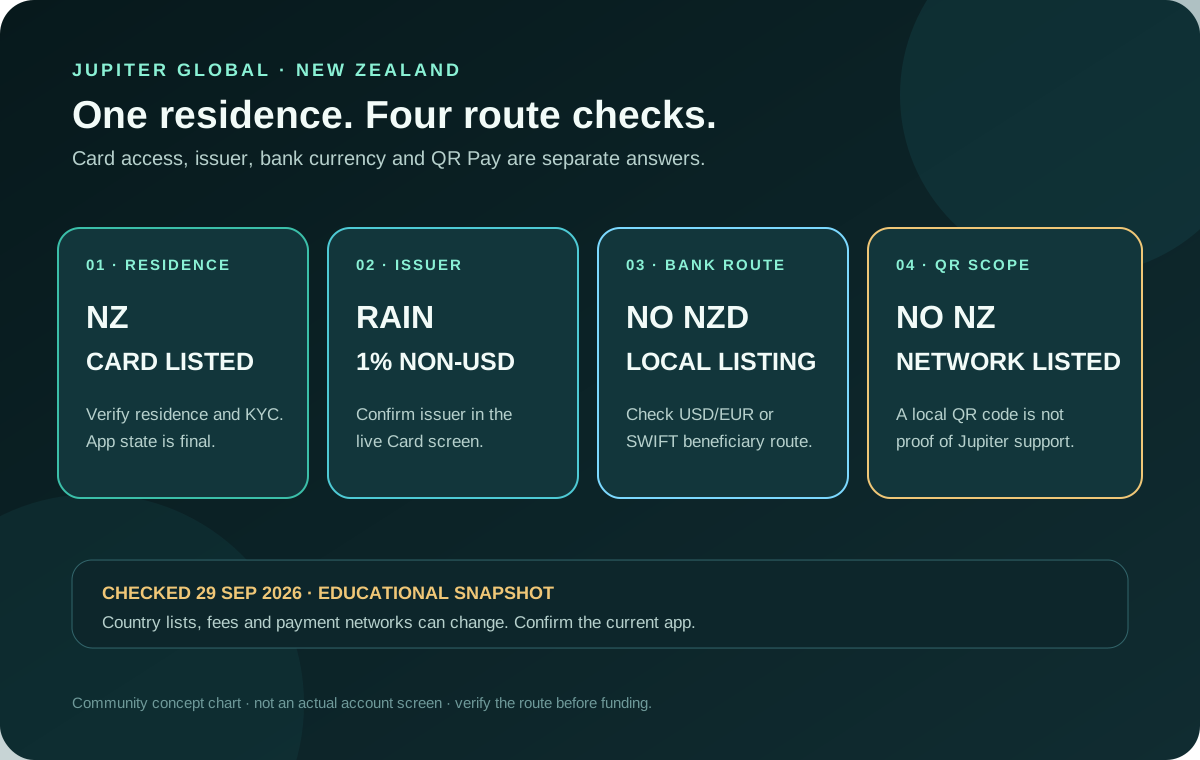
With Jupiter Global New Zealand, keep the Card question apart from payouts and QR payments. New Zealand is listed as a supported Card country of residence, but that does not create a local NZD payout or a New Zealand QR network. The useful answer is a route check: Card eligibility, issuer, currency, bank destination and merchant payment are different gates.
The New Zealand answer at a glance
| Route | What the current documentation supports | What still needs a live check |
|---|---|---|
| Jupiter Card | New Zealand appears in the supported residence list | Identity verification, account status and the options shown in the app |
| Issuer | New Zealand is outside the documented DCS residence list, so the country split points to Rain | The issuer displayed on the account and the final transaction screen |
| Non-USD Card spending | The current Rain fee is 1% on non-USD payments | Merchant currency, exchange rate and final authorization amount |
| Local bank payout | NZD is not in the current local-payout currency list | Whether a USD or EUR/SWIFT route is available for the specific beneficiary |
| QR Pay | New Zealand is not in the current merchant-network list | The app’s current feature state and the merchant’s actual payment rail |
Jupiter says product availability depends on residence, regulation, partners and the account state shown in the official app. Current Card countries · Spend risks
Can a New Zealand resident get the Jupiter Card?
The current Card documentation lists New Zealand among the actively offered countries of residence. Eligibility is based on residence rather than citizenship, and the account still must complete the identity-verification flow. A New Zealand citizen living elsewhere should use the residence shown during onboarding rather than assuming citizenship controls the issuer. Card residence rules
The same documentation describes the virtual Card in the Jupiter app, while physical cards are rolling out in phases. A supported New Zealand residence therefore answers the Card-country question; it does not promise that the physical-card order option is already visible in every account. Check Spend → Card in the official app before planning around delivery.
Which issuer and fee applies in New Zealand?
Jupiter documents two Card issuers. DCS is listed for Australia, Japan, Malaysia, the Philippines, Singapore, South Korea, Taiwan, Thailand and Vietnam; residents of other supported countries receive a Rain-issued Card under the documented country split. New Zealand is not in that DCS list, so the current documentation points to Rain for a New Zealand resident. Confirm the assigned issuer in the live account before relying on a fee or limit. Issuer assignment
The fees table lists 1% for Rain on non-USD Card payments and no FX fee for payments made in USD. That is the issuer’s conversion fee, not a promise about the merchant’s own price or the exchange rate displayed at checkout. A New Zealand purchase in NZD should be reviewed on the final authorization screen, including the merchant amount and the total debit from the USD Spend balance. Current Card fees
Rain is also documented with no Card spending limit in the current table, while DCS has stated daily and annual limits. “No limit” in a public table is not permission to ignore fraud controls, merchant restrictions, account status or the amount the app actually allows. Use the live Card controls as the final check.
Is there a New Zealand bank payout or NZD account?
Do not treat a supported Card country as proof of a local bank payout. Jupiter’s current remittance page lists local payouts in AED, BRL, CAD, EUR, GBP, IDR, INR, MYR, NGN, PHP, SGD, THB, TRY, USD and VND. NZD is not in that current local-payout list. The page says other destinations may use SWIFT in USD or EUR, subject to corridor, bank and regulatory restrictions. Current remittance currencies
Jupiter also describes USD and EUR virtual accounts after Jupiter ID verification, with EUR availability potentially depending on residence. Incoming fiat transfers credit the Spend balance; USDC is not deposited directly into a virtual account. That means a New Zealand resident should check which destination currency and rail the account shows, rather than assuming a domestic NZD account number exists. Virtual-account conditions
Fees apply to both deposits and payouts. The current table gives each rail and destination its own fixed and variable fee; payout limits are set for each currency and shown in the app. A visible balance, a virtual account or a SWIFT option does not guarantee that a recipient bank will accept the transfer. Check the beneficiary fields, quote and corridor before sending. Transfer fees and limits
Does QR Pay work in New Zealand?
The current QR Pay documentation lists merchant networks in Cambodia, Indonesia, Malaysia, Mongolia, the Philippines and Vietnam. Singapore SG QR and Thailand PromptPay are marked temporarily unavailable. New Zealand is not in the current documented QR network list. A New Zealand merchant QR code may belong to a bank or wallet rail that Jupiter does not support, so a familiar-looking code is not evidence of compatibility. QR Pay markets
QR Pay is also a separate card and issuer gate. The documentation currently says it is available on DCS-issued cards only, with additional activation-date rules in some markets. A Rain-issued New Zealand Card should therefore not be funded on the assumption that a QR option will appear later. If the goal is an ordinary merchant purchase, use the Card route; if the goal is a bank transfer, use the remittance route.
New Zealand onboarding checklist
1. Use your real country of residence and complete the official Jupiter ID verification flow. 2. Confirm the issuer shown in Spend → Card before calculating non-USD costs. 3. For an NZD purchase, read the final Card authorization rather than converting a headline balance estimate. 4. If you need a bank payout, check whether the account offers USD, EUR or a specific SWIFT/local route; do not assume NZD support. 5. Treat QR Pay as a separate network check; New Zealand is not in the current documented merchant list. 6. Keep a transaction reference and use official support if the account and documentation disagree.
The site’s Route Finder can help you pin down your goal, while the residence checker can organize the questions. Keep identity documents, account credentials, PINs, one-time codes and recovery phrases out of community messages. Official support route
In short, for New Zealand: the Card is a documented residence route, Rain is the expected issuer under the current split, NZD local payout and QR Pay are not documented as available routes, and the live app controls the final decision. If the Card suits you in New Zealand, get started with Jupiter Global and check the issuer and fees before you spend. Eligible Jupiter Card purchases earn 2% cashback, up to $100 a month.
Jupiter Global New Zealand FAQ
Is New Zealand supported for Jupiter Global?
New Zealand appears in the current Jupiter Card supported-country list. Eligibility still depends on residence, identity verification and the options shown in the official app.
Which issuer does a New Zealand resident receive?
New Zealand is outside the documented DCS country list, so the current split points to Rain. Confirm the issuer shown on the account before relying on the fee table.
What is the Rain Card FX fee for New Zealand spending?
The current fees page lists 1% for non-USD payments on Rain-issued Cards. The final amount also depends on the merchant currency, exchange rate and authorization shown in the app.
Can Jupiter Global send NZD to a New Zealand bank account?
NZD is not in the current local-payout currency list. The remittance documentation describes USD or EUR virtual accounts and SWIFT routes for other destinations, subject to the account, beneficiary bank and corridor.
Does Jupiter QR Pay work in New Zealand?
New Zealand is not in the current documented QR Pay merchant-network list. QR Pay also depends on the card issuer and market conditions, so a New Zealand QR code is not proof of compatibility.
Sources
Checked against these sources on 21 October 2026.