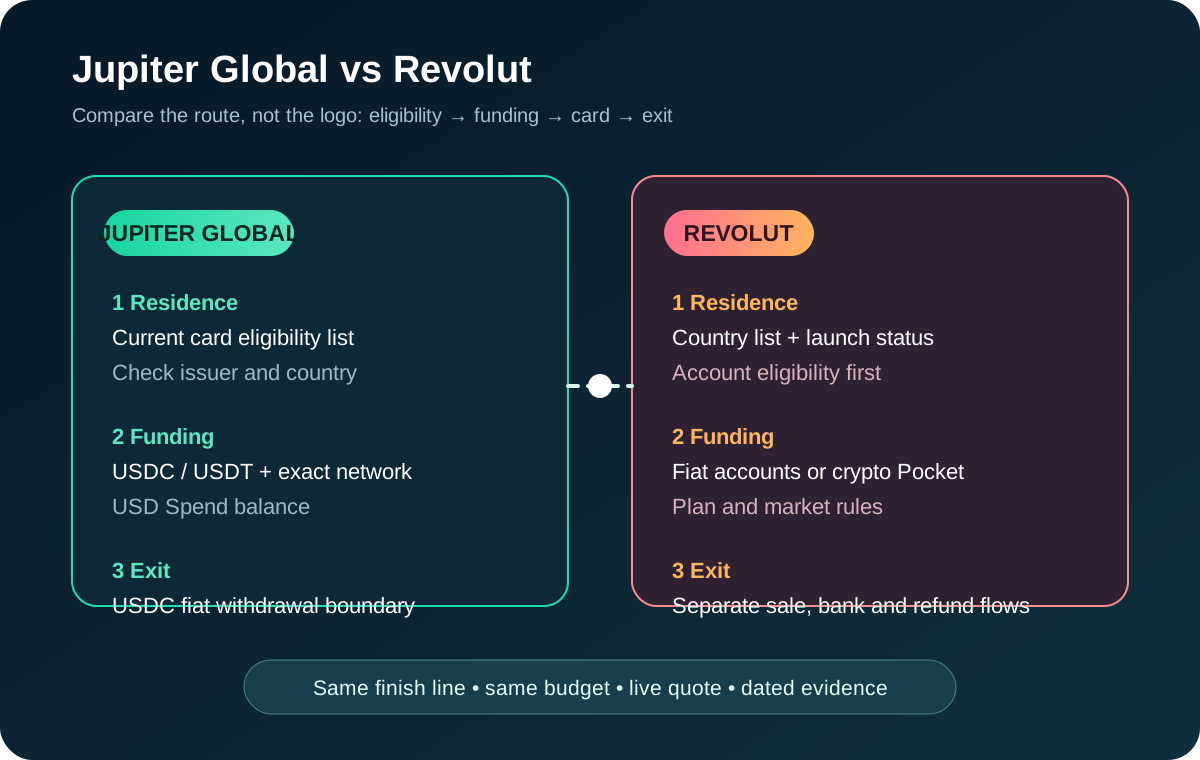
Jupiter Global and Revolut work differently. Jupiter’s documented Spend product starts with a USD balance that can be funded with supported stablecoins and used through a card. Revolut starts with a country-eligible account, fiat balances and its own card; in some markets it also lets a card spend from a crypto account. The best choice depends on where your money starts and what you need to do next.
Keep the Jupiter Global guides directory open while you compare the route. It links the current card, funding, transfer and incident checks used by this page.
The short comparison
| Question | Jupiter Global | Revolut |
|---|---|---|
| First gate | Residence must appear in the current Jupiter Card eligibility list | Personal account availability depends on the current country list and local launch status |
| Main funding model | Direct USDC or USDT deposit on the documented network and asset combination, or an in-app transfer route | Bank transfer, card and account balances; crypto spending is a separate account and product path |
| Card balance | USD Spend balance; the display currency does not change the underlying balance | Selected fiat accounts or, where available, a crypto account linked to the card |
| Crypto card behavior | Supported stablecoin is deposited into Spend before card use | Revolut exchanges crypto into the purchase currency at payment; crypto card payments do not earn cashback according to the cited help page |
| Foreign-currency check | Current public table lists Rain 1% or DCS 1.8% for non-USD card spending, depending on issuer | Plan, currency, market and fair-usage rules must be checked in the live Revolut app |
| Exit question | Only USDC deposits are documented as eligible for fiat withdrawal; USDT deposits cannot be withdrawn to fiat | Crypto sale, bank transfer and card refund are separate flows; a crypto card refund is returned in fiat |
This is a route map, not a live approval or price quote. Residence, issuer, supported assets, card controls, limits and fees can change. Read the current Jupiter Card documentation, Jupiter Fees & Limits, and the relevant Revolut country page before acting.
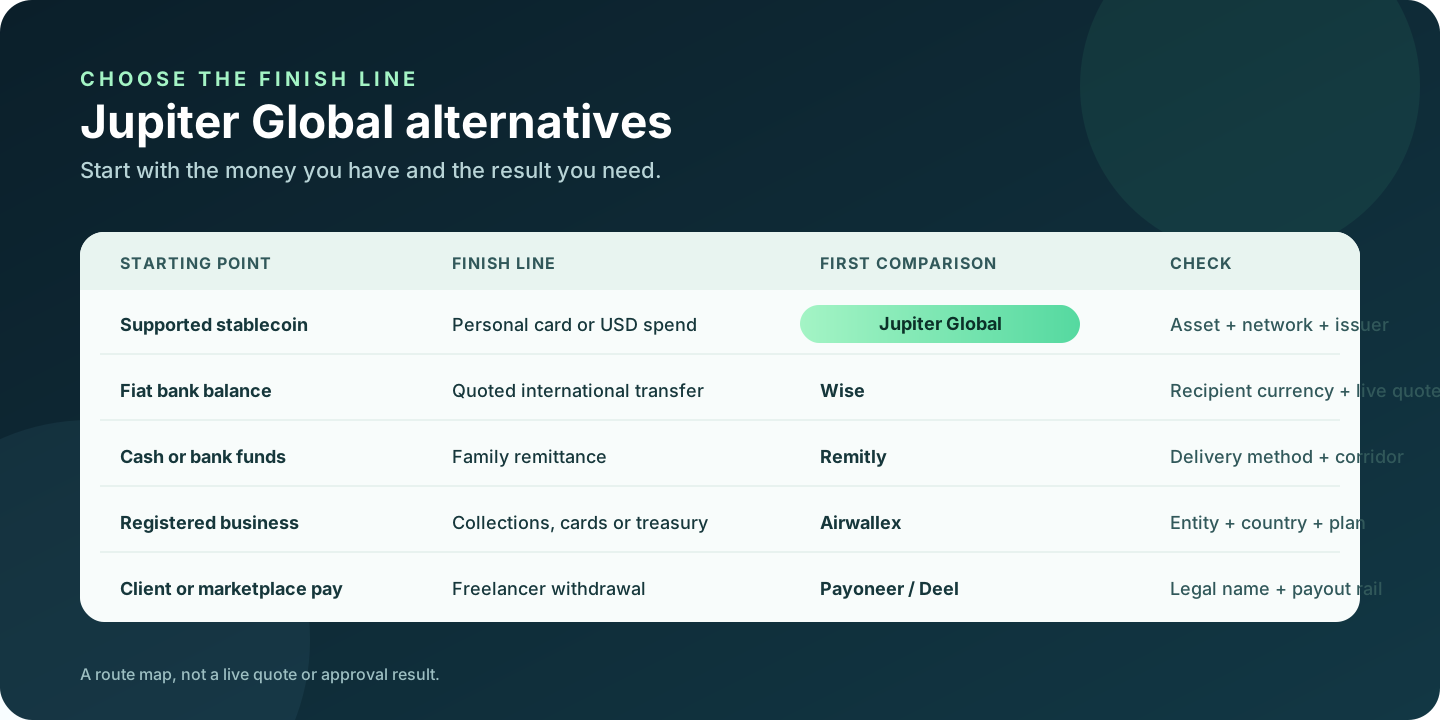
Start with what you need the money to do
Write down the outcome before comparing logos:
- Spend stablecoins through a card: compare Jupiter’s supported deposit route with Revolut’s crypto-account card path, if that path is available in your market.
- Hold salary or bank money in several currencies: compare Revolut’s account and local banking features with the separate Jupiter virtual-account route.
- Pay a USD subscription: compare the final card billing currency and the source balance, not the app’s display currency.
- Move money to a bank: compare the exact payout corridor, total debit, recipient amount and delivery estimate. A card product is not automatically a remittance product.
Compare routes that end in the same place. A card purchase, a bank transfer and a crypto sale may all contain the word “spend,” but they have different fees, settlement and failure points.
When Jupiter is the route to investigate
Jupiter is worth investigating when you already hold supported USDC or USDT and want a dedicated Spend balance plus a card. Its FAQ documents direct deposits of USDC on Solana, Ethereum, Sui, Arbitrum or Base, and USDT on Solana. An unsupported asset or network can be lost, so the current receiving screen is the authority. Deposit and funding FAQ
The card balance is USD. The current fee table lists no FX fee for USD card spending and a Rain or DCS percentage for non-USD spending. That gives a practical test: if the merchant charges USD, check the final billing currency; if the merchant charges another currency, include the issuer’s current FX row and any merchant authorisation hold. Do not treat a display-currency setting as a conversion or a quote. Spend overview · Current fees
Jupiter’s route also makes the exit boundary visible. The current documentation says only USDC deposits can be withdrawn to fiat, while USDT deposits cannot. If your real goal is a bank payout, check the account’s actual corridor before depositing. Card residence eligibility does not prove that every payout currency or rail is available.
When Revolut is the route to investigate
Revolut is worth investigating when your need is fiat-first: an eligible local account, bank funding, several fiat balances or a card connected to those balances. Its account-opening list is market-specific and may include waiting-list or launch conditions, so the country list is a first gate rather than a worldwide promise. Revolut supported countries
Revolut’s card-use page says its physical and virtual cards can generally be used where Visa or Mastercard are accepted, subject to listed country restrictions and the account’s controls. That describes where an issued card may be used; it does not prove that a person can open an account or order a card in every country. Where Revolut cards can be used
The crypto-card path is also different from a direct wallet deposit into Jupiter. The cited Revolut help page says a card can be linked to a crypto Pocket, and Revolut exchanges crypto into the purchase currency when the payment is made. It also says that crypto card payments do not earn cashback and that a refund is returned in the fiat currency of the purchase. Check the current plan, market and crypto terms before treating that route as equivalent to stablecoin-funded Spend. Revolut crypto payments
Compare the complete cost
Use one test transaction and record the evidence at the same time:
1. Country of residence and account type. 2. Starting asset or currency and the funding rail. 3. Merchant currency and final amount charged. 4. FX, fixed charges, spread or plan allowance shown at confirmation. 5. Refund behavior and the currency returned if the purchase is reversed. 6. Any withdrawal or bank-transfer step needed after the card payment.
Jupiter’s published issuer table gives a reference point for its FX rows. Revolut’s cost can depend on plan, market, currency, timing and fair-usage rules. Do not compare one provider’s published percentage with another provider’s introductory or plan-specific headline. Use the actual final debit and the amount of usable value received.
Use the site’s Route Finder to name the destination, funding source, and goal before comparing products. The Quote Compare tool can then calculate an effective rate from figures you enter. Neither tool fetches live provider prices, inspects account eligibility, or decides which service is safer.
How to choose
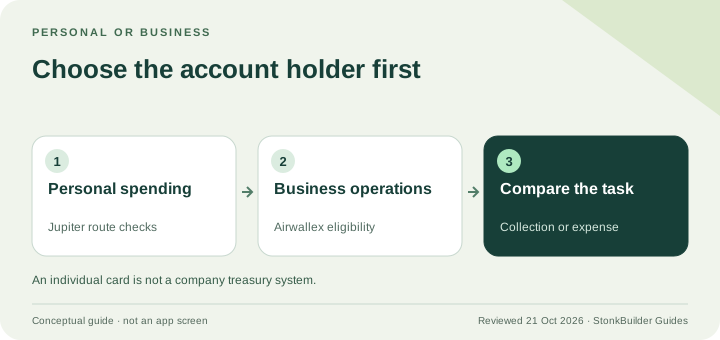
Choose Jupiter when the account is eligible, your supported stablecoin and network are ready, and the card or USD Spend balance solves the actual job. Choose Revolut when the account is available in your country and its fiat, bank or card route reaches the same outcome with a better complete quote or simpler recovery path. If the routes end in different currencies or products, keep the comparison separate instead of forcing a winner.
Before funding either service, verify the country, issuer, asset, network, merchant currency, fee row and exit route in the live product. Use a modest first amount, keep the confirmation and have a backup payment method. If Jupiter is the better fit for you, read the official app-download guide and create your Jupiter Global account; eligible card spending earns 2% cashback, up to $100 a month.
Jupiter Global vs Revolut FAQ
Is Jupiter Global or Revolut better for spending crypto?
It depends on the route. Jupiter is the first route to investigate when supported stablecoins are deposited into a USD Spend balance before card use. Revolut’s crypto-card route, where available, exchanges crypto into the purchase currency at payment and follows separate market and plan rules.
Can I open Revolut anywhere Jupiter Global supports a card?
Do not assume it. Each provider has its own country, launch and account-eligibility list. Check the live account-opening route for your residence; a card-use list does not prove that a new account can be opened there.
Does Revolut’s crypto card work like a Jupiter stablecoin deposit?
No. A Revolut crypto card can spend from a linked crypto account under its conversion rules, while Jupiter’s documented flow deposits a supported asset and network into Spend before card use. The funding, settlement and refund paths differ.
Which provider is better for bank transfers?
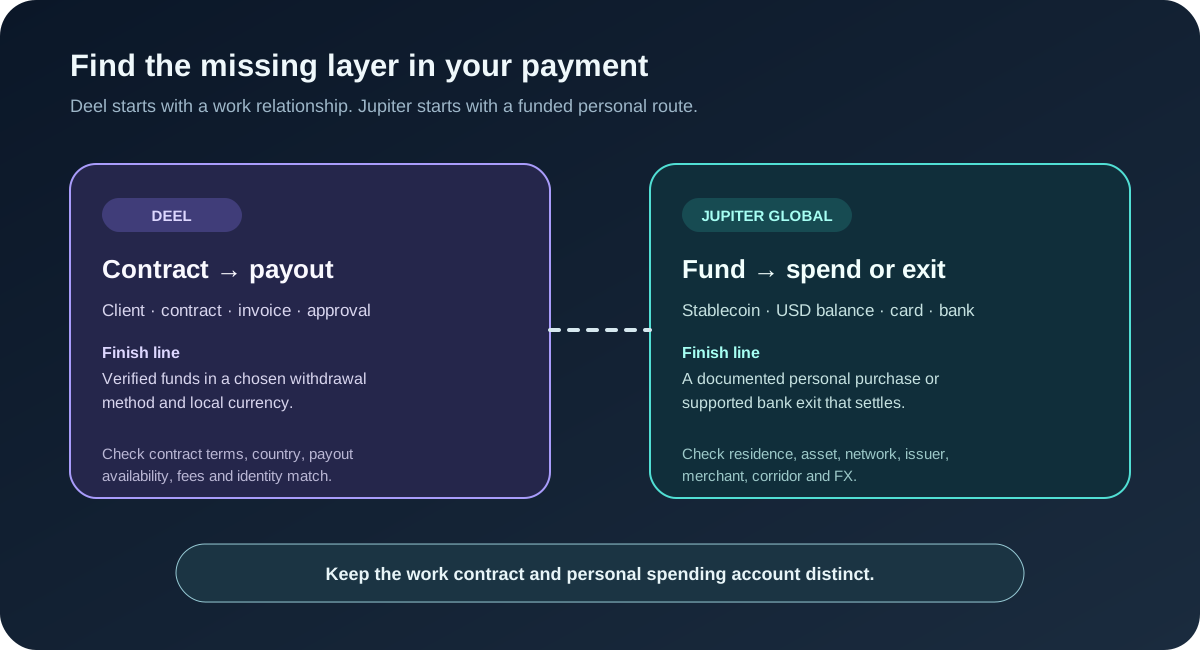
Compare the exact payout or bank-transfer corridor rather than the card brand. Jupiter’s route depends on the verified account, asset and destination; Revolut’s route depends on the eligible account, currency, plan and local banking features.
What should I record before choosing?
Write down your residence, starting asset or currency, funding rail, merchant currency, final debit, FX or plan charge, refund currency and any bank-exit step. Recheck the live confirmation screen before funding either service.
Sources
Checked against these sources on 7 October 2026.